*This is an early version of a chapter in my upcoming book, Saturn’s Maw: Essays and Aphorisms for the Living and the Dead
Suggested Listening: Worlds Theory Playlist
“But from the point of this view the troubles and symptoms from which this person seeks relief, and the unconscious factors behind them, cease to be merely psychological. They lie in the whole pattern of his relationships with other people and, more particularly, in the social institutions by which these relationships are governed: the rules of communication employed by the culture or group. These include the conventions of language and law, of ethics and aesthetics, of status, role, and identity, and of cosmology, philosophy, and religion. For the whole social complex is what provides the individual’s conception of himself, his state of consciousness, his very feeling of existence.” – Alan Watts, Psychotherapy East and West
“We may not be responsible for the world that created our minds, but we can take responsibility for the mind with which we create our world.” – Gabor Mate
The Circuitry of the World
Let’s begin with a few questions to frame the next leg of our journey: if our starting point for the basic reality of conscious experience is that we are jewels in The Net in any way, shape, or form (i.e. not separate selves), then how on earth and heaven does a jewel ever become fully convinced it is a tiny, isolated stone adrift in a meaninglessness universe? And how the hell do we find our way back to operating from the awareness of being a jewel in The Net as our basis? For many of us, we are socialized and conditioned to be skeptics of whether this is even possible, let alone desirable. Having a separate self is the whole idea, right? Many approaches in popular culture to healing and traumatology emphasize boundaries, emotional regulation, and identifying harmful family dynamics from the assumption that having a separate self is the pinnacle of healing. We will agree for many of our experiences of enmeshment in traumatizing family systems where we never get the safety and love to be our true, authentic selves. And we will say this is only halfway on the journey back to The Net. In trauma healing terms, we might pose the question this way: is it possible to fully heal and become whole again? When put in the terms of healing and referencing the original meaning of to heal (i.e. to become whole), we can see that at a certain point where healing comes to the chasm and need for the bridge to spiritual liberation and freedom, the question itself reveals its own limitations. If I am already whole and not a separate self, how do I ever become something I already am? What we get an intimation of here is that healing becomes something much different than it first appeared from the other side of the bridge to spiritual liberation and existential freedom.
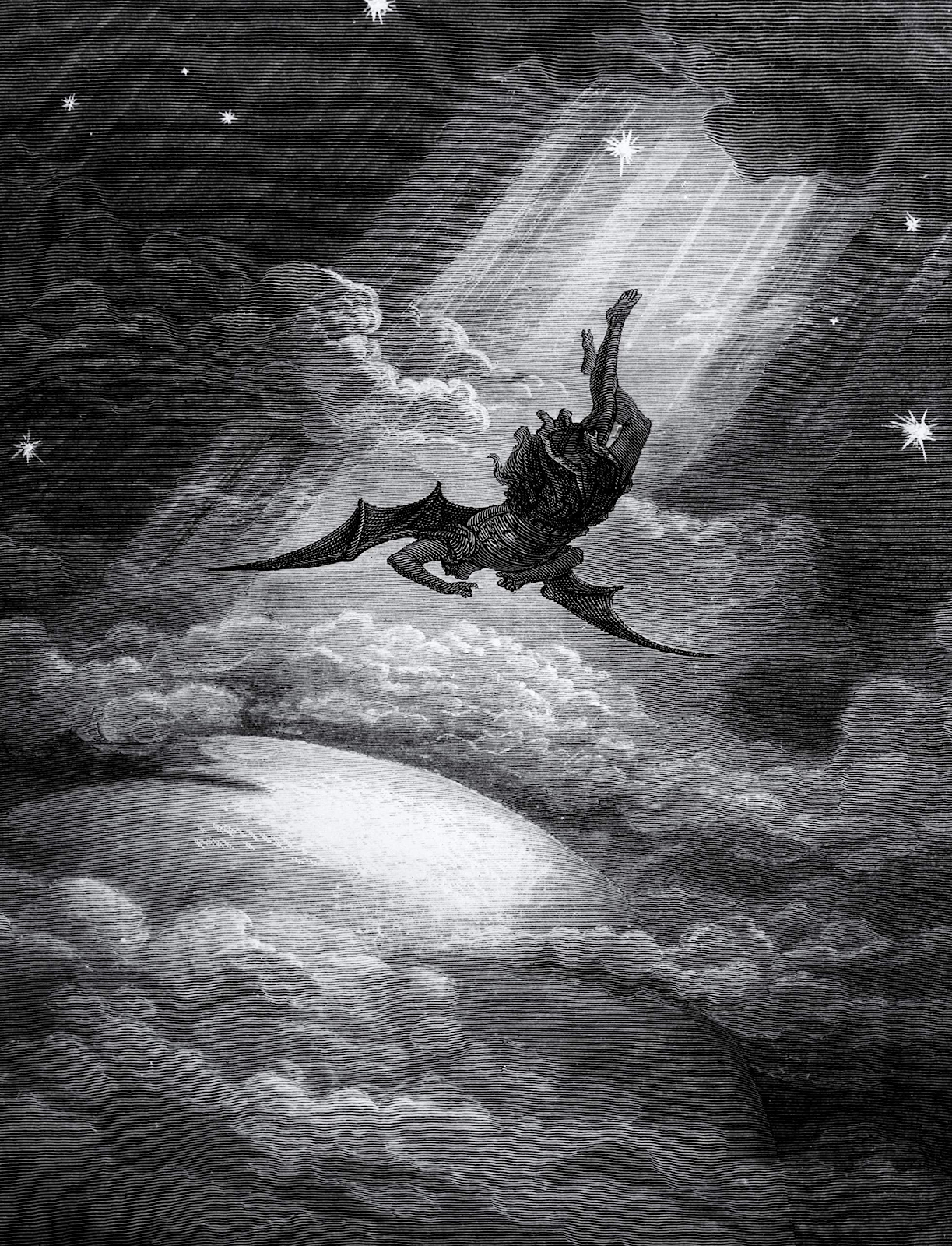
Human beings are inextricable from the fabric of reality itself. As Alan Watts once said, the way an apple tree apples, the universe peoples. What traumatic wounding does as perhaps its greatest act of delusion and destruction is to create a set of conditions and emotional learnings (schemas) which fundamentally shut off any awareness that this is the core truth of your existence. We cannot blame our nervous systems for doing this, however. Being part of The Net when the jewels around you do not reflect you but instead react to you with cruelty, hatred, or indifference is too intolerable for any being throughout their early development or if experienced with enough consistency. Without a massive arsenal of love, care, support, and skillful means to process and integrate that experience, what else could we do but shut off our feeling of connection to The Net? In place of a jewel in The Net, you are now a meaningless particle of dust floating in the vacuum of outer space out of necessity. The greatest trick trauma ever pulled is to utilize the illusion that the separate self exists to help us survive. In my own healing journey, I’ve found that the fascinating implication of this trick is a bit like Lucifer’s fall from heaven in Milton’s Paradise Lost. The self (or usually our “ego”) which is so easily identified as the villain of the story unintentionally becomes the hero with the greatest redemption arc. And this happens all as an unconscious implication unbeknownst to the author of the drama. And just as Milton would vehemently deny that Lucifer was the unintentional hero of his mythological glorification of his story, the self also appears as our greatest protagonist in an antagonist’s guise. And it is the great spiritual and philosophical quest to see and reconcile its small role and function in a much larger and more total reality.
How do we attempt this feat of returning to The Net when it has been so strategic, so coherent, to wall up inside the fortress of the separate self? My own answer has required going through the nervous system and the theories of Interpersonal Neurobiology, existential philosophy, and Buddhist practice among other frameworks to map the way back home. It has taken me to a place where the boundaries between our bodies, our minds, and the world we exist in start to blur and become permeable. It fundamentally must reveal how this pesky but useful illusion of the self gives rise to suffering and also explicate the world it arises in that causes the suffering. For the self and world, as Rollo May has said, are two aspects of one dynamic process. As various schools of Buddhist philosophy have identified for thousands of years going back to the realizations of Shakyamuni Buddha himself, our attachment and grasping, which is the primary reason why we suffer, originates from this experience of having a separate self. We will take this Buddhist insight as a core aspect of our approach while also including theories such as Interpersonal Neurobiology, existentialist philosophy, attachment theory, and Marxist critical theory to extend this perspective to the world we exist in, as well. This combination of approaches is crucial to overcome the inherent assumptions within many of the frameworks for healing based in scientific materialism which our approaches to healing and emotional learnings unconsciously originate within. For while the power of scientific materialism as a worldview and philosophy cannot be denied, it also crashes upon the rocks of reality when our healing reaches the limits of what the self/other dichotomy can do for us. This synthetic approach is also fundamental to cross the gaps arising from the limitations for culture, society, and interpersonal relationships present in so many spiritual practices and philosophies, as well. Healing and becoming whole (the original root of healing) can never fully be accomplished by a framework that can only reduce us to biological and material processes or that does not provide us a way to see the larger contexts and deeply emotional and relational world where the separate self arises from. What it is to be wounded can never be reduced to biological, social, or spiritual processes because woundedness always involves pain and suffering across all levels of our individual and collective experience.
Of the many frameworks of how trauma impacts, fragments, and wounds us across our various levels of experience,Interpersonal Neurobiology (IPNB) is perhaps the one developed thus far in the mental health realm with the most explanatory power and usefulness any kind of soteriological metatheory we are developing here. It also has great implications for the wisdom of spiritual practices and nonordinary states of consciousness with psychedelic medicines to become more aware of the codependently arising conditions of the larger social, cultural, and political contexts where our suffering arises. This expansive model of the mind emerged from an interdisciplinary endeavor to find common ground on a definition of what exactly is the mind. One key feature of this endeavor was that their definition of the mind must be one that spans disciplines and can help them create a shared language. So IPNB is from its very beginning interdisciplinary which is of great importance for the approach we are developing here which is also inherently interdisciplinary by necessity. In IPNB, the mind is defined not as a thing but as a system of relationships that are constantly changing and occurring as a process. It is dynamic and a flowing process of energy and information comprising our nervous system (brain and all our physiology) and with its environment (relationships, social environment, material conditions, politics, economics, ecology, etc.). The mind is specifically that part of this process which regulates the way that information and energy are flowing through the circuit or feedback loop of the entire process. It is the whirlpool-like formation we discussed in Part 1 that can be a useful metaphor for how the self exists, as well.
And as with any good model, it lends itself well to imagery of how the model works:
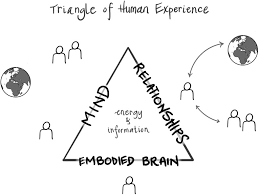
Notice in IPNB’s model, the place of the world is included in “relationships” which encapsulates the entirety of a vast and complex web of systems and institutions which are not explicitly named. And while the model is process-based and exploring interdependence as definitional of our experience, there is not any explicit way to incorporate the layers of existential and spiritual experience without reducing it to some idea of being “integrated” in the model as a primarily biological experience in a scientific materialist framework. And there is another primary question to consider with IPNB’s model of the mind that a philosophical spirit of defining our terms makes evident. Considering that information and energy are agreed upon by all the various disciplines in IPNB’s approach as being essentially what the mind is about, what exactly are information and energy in a model that seeks to understand the mind, self, and the way we relate to the world? Some simple definitions from physics would offer that information can be defined as anything which reduces uncertainty about the state of a system. And energy can be defined as the capacity to do work of some kind or another. Energy is also an inherent property in any system which can be transformed and transferred between various forms but can not be created or destroyed. So our inquiry would lead to a conclusion that in IPNB’s model of the mind and self, they are primarily about how much relative uncertainty or organization about the state of our system and how much energy we have at our disposal to do work or to transform that system. IPNB offers us a great leap in understanding how trauma impacts and shapes us by clearly stating that it affects how much uncertainty we have about our own systems and how much energy we have at our disposal at any given time to respond to what is arising in our experience of reality.
In IPNB, both the mind and the self are seen as emergent properties of this dynamic flow of information and energy between our nervous systems, other beings, and the physical environment. They arise from the embodied mind and nervous system in the intersubjective field and the larger material context they exist in. This already is quite a challenge to any notion of separate self as we experience it in our day-to-day consciousness. What we are conceptualizing as a world is all that emerges in the codependently-arising experience of the mind and self that is based in IPNB’s model. And we are extending IPNB’s conception of the relationships in its Triangle of Human Experience to include a vast array of systems we are in relationship with. But the concept of a world also goes further: a world also includes as primary the larger context which the mind and self emerge in as a primarily existential and spiritual experience within time and space. In a world, the experience of spacetime through the layers of our spiritual and existential consciousness and awareness are primary as they shape how we experience every system and other layer of experience we exist within. And we can come to know these aspects of the world primarily as alterations of consciousness within how the mind and self operate as schemas within the intersubjective field and our relationships with self and the world around us. As opposed to a perspective that starts with scientific materialism as its basis and tries to understand and explain the spiritual and existential experience of consciousness through that lens, we are starting (in the same spirit as Yogācāra and other spiritual philosophies) with the existential and spiritual experience of consciousness as primary and will utilize scientific materialism as a useful set of tools as needed.
So our basic expansion of IPNB’s model of human experience is to imagine it as the Triangle of Experience circuit/feedback loop but within a much larger set of fields. And there is no better model of what those larger fields in psychology and the social sciences than Urie Bronfenbrenner’s Ecological Systems Theory (EST). Imagine the triangle model of IPNB overlayed where you see the “Individual” in this diagram of EST:
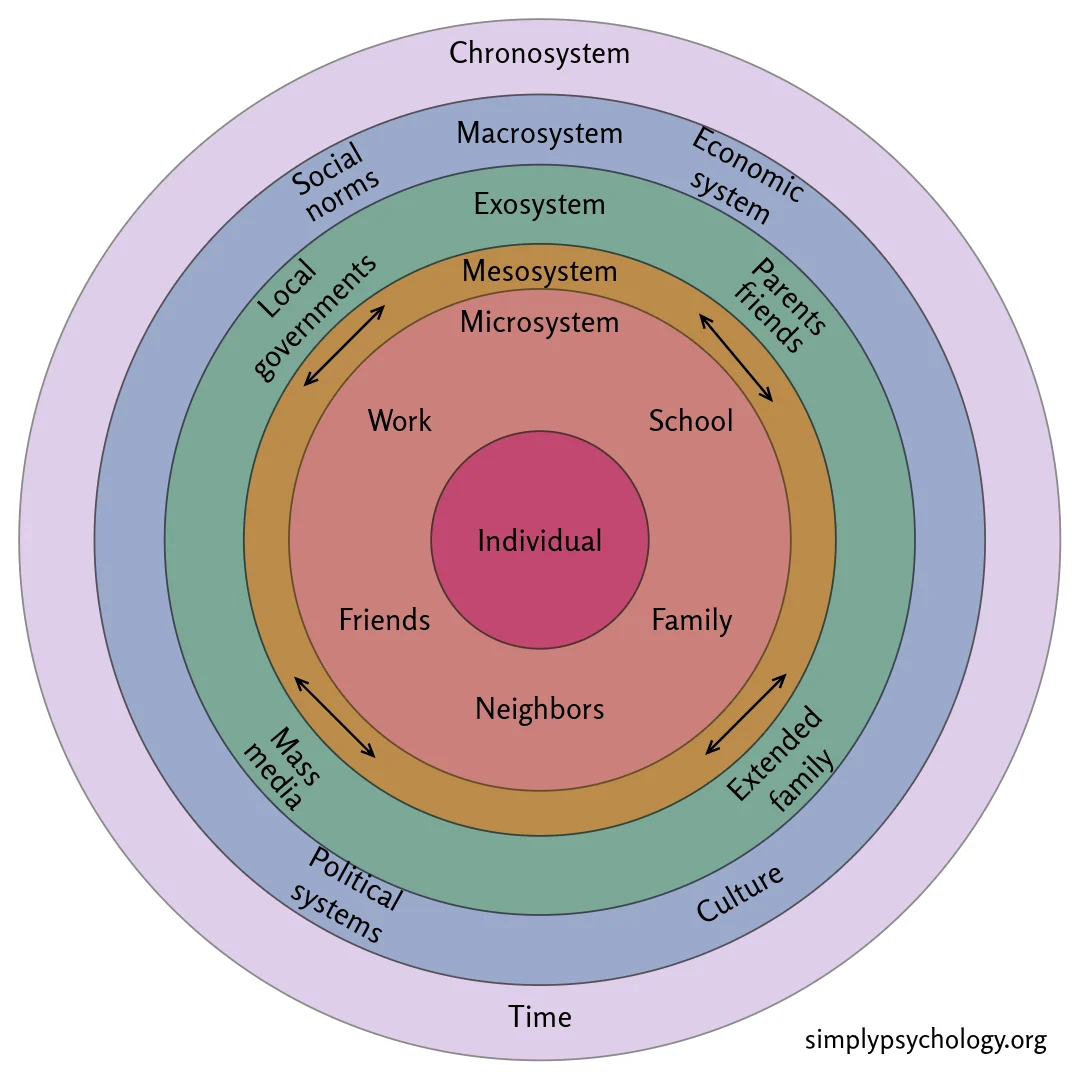
What psychedelic explorations of non-ordinary states of consciousness and spiritual practices add to both the IPNB’s and EST’s models are ways to have direct experience of how our existential and spiritual layers of experience in spacetime are constantly shaping the world as we experience it through dynamic interactions in our relationships with ourselves, others, and the various cultural and social systems around us. In short, they show us that it is our mind and self which is shaping how we experience the world and actively construct it in relationship with others around us. They can show us that the entire world is the mind and the mind is the entire world. There is nothing that we can or do experience in terms of information and energy that is not being actively regulated by the mind in each passing moment. And that it is possible to actively intervene and shape how the mind is regulating information and energy. Imagine the individual circle is actually a three-dimensional shape where existential and spiritual experiences are the base layer both above and below all of EST’s layers of systems. If we start to shift our dimensional awareness of the model, IPNB’s Triangle of Human Experience becomes a way to visualize dynamic circuitry of the mind and self codependently arising with the entire social and cultural systems that make up our worlds. We gain awareness that the mind and self are not primary but are arising dynamically as a process, not a thing. It is through accessing those levels of experience granted by both psychedelic medicines and spiritual practices (of which meditation is but one tool) which can grant access to this awareness. This is why it is often nonordinary states of consciousness via psychedelic molecules and mystical experiences which radically alter our functioning in the nested systems we exist in and provide a radical reconfiguring of the self as something emerging from those systems. We also see that the processes and experiences of healing our individual and collective traumas can grant access to this level of experience. Healing fundamentally alters one’s experience of consciousness itself and our conceptualizations and experiences of the world. For many of us, it is the most important gateway into the awareness of how we are actively constructing the world in every given moment with everyone around us. The world in our sense is where the bridge from healing to spiritual liberation and freedom can be found.
A Theory of Worlds
We contend the best way to understand and know how to practically intervene in the core experiences of trauma, especially with developmental trauma disorders or Complex PTSD, comes from conceptualizing how to do so through the ways they are experienced directly and holistically from within those worlds across all levels of systemic experience (in an EST and IPNB sense). And that the different states of consciousness and alterations in our experience of spacetime and self which are primarily registered at the layers of existential and spiritual experience directly point to what and why trauma does what it does to us internally. We are proposing a new metatheory which can integrate these aspects of the worlds we exist in now, the worlds of our past, and how to actively shape and integrate our experiences of them through firsthand experience and experimentation (in a similar spirit to Pete Walker’s work on Complex PTSD). We will call our soteriological metatheory from this point forward Worlds Theory (WT). Our framework seeks to explain exactly what happens inside of us and why as the result of traumatic experiences. And it aims to do more than just this (though this is perhaps more than enough for some): to bridge the gap between healing and the spiritual and philosophical quest with a clear and understandable perspective of how healing and spiritual liberation can act as two parts of one path. As one of my Zen teachers, Kokyo Henkel, says, “Zen practice is 70% healing and 30% liberation.” WT would give us a framework of how to navigate that 70% of healing in a way that inevitably takes us to the bridge to the 30% of spiritual liberation and freedom through how we confront the function and necessary illusion of the separate self.
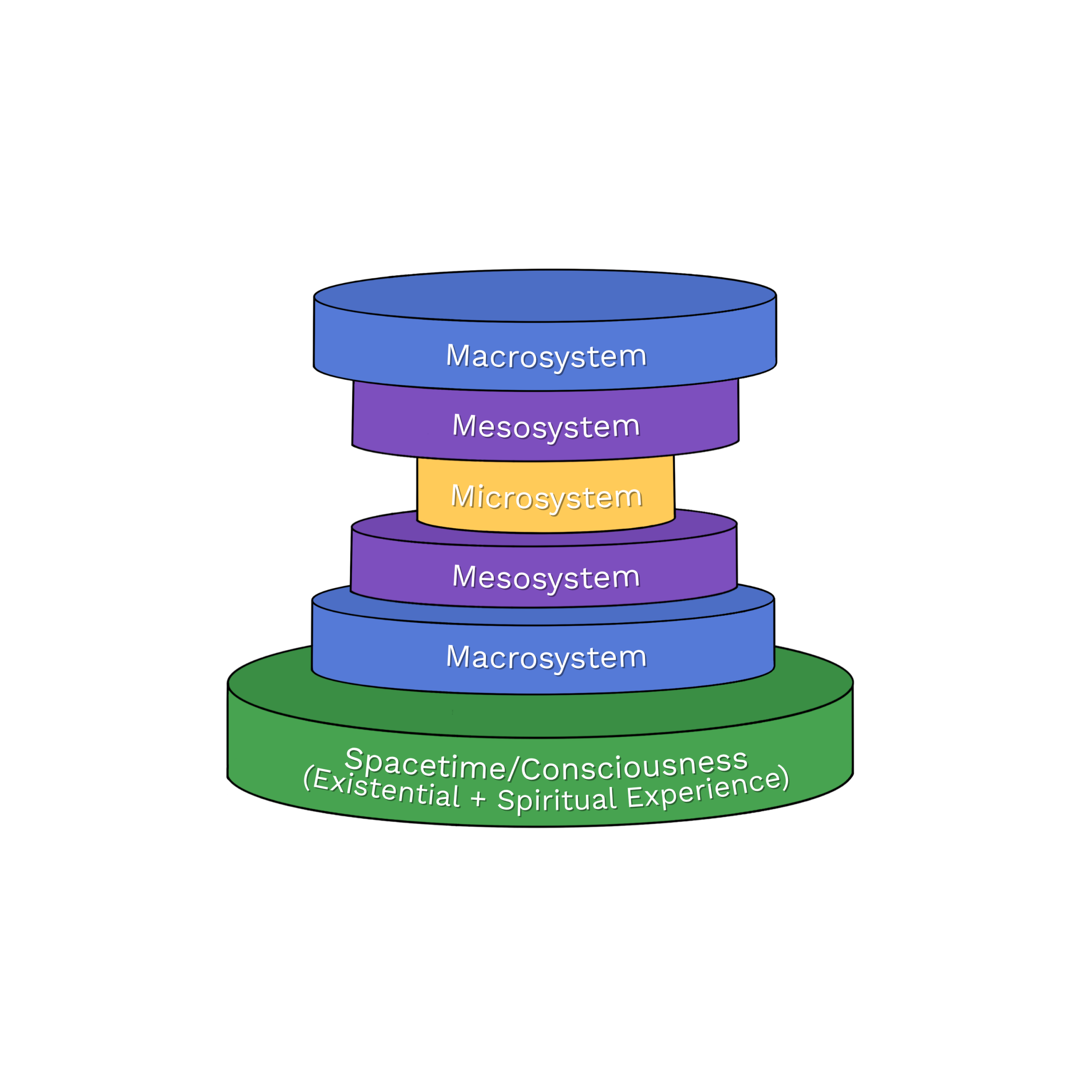
To begin mapping how WT conceptualizes our experience of a world, we will start by extending Bronfenbrenner’s Systems Theory model into three dimensions. We will also add in our layer of existential and spiritual experience at the base layer of our subjective experience of these systems as we only know these systems through our subjective conscious experience of the world:
Worlds Theory Model of Experience
Copyright of Adam Kadmon, LCSW-S
Each specific layer or system of the worlds we exist within make up both the foundation of the schemas of the self (or microsystem). And the self and microsystem reflect outward and into the larger systems of mezzo and macrosystems of which we participate and actively construct. In WT, the self is a specific and dynamic node in a vast feedback loop that makes up our world. At its heart, the self and the world it is arising from are primarily relational, not separate. The self is both being influenced but also can influence the systems of which we arise from and this agency or potential arises from the schemas of the self. Philosophers like Michel Foucault with his concept of disciplinary society and power/knowledge or Bruno Latour and the Actor-Network Theory (ANT) also sought to understand the self as primarily shaped and structured by technology, politics, and economics in a similar way as in WT. The self we have is one that is profoundly constructed by the forces that are shaping it and, in our current conditions, then reinforce the very functioning of systems that shape it such as a capitalist economy and a highly individualistic society of atomized individuals that are in competition with each other. Similar to Latour’s ANT, WT also begins from the starting point that the self also arises in networks of interactions between our nervous systems, inanimate objects, and ideas, as well. Even our experience of time and space are also greatly influenced by the ways the macrosystem and mesosystem can radically alter our subjective experience of the spacetime continuum through the development of technologies like the clock, the airplane, or the smartphone, for example.
Our schemas for subjectivity (being alive), perception (center of our experience), and agency (what power do we have to act in the world) are constrained or expanded by these forces. But WT, in opposition from the standard scientific materialist view shared by many of the philosophies like ANT, does not take the experience of the systems of the world as all there is. Instead, we operate from the existential and spiritual foundation that our consciousness and subjectivity are both shaped by these forces but we can in fact find enormous power to transform our experience through direct intervention on how we perceive and experience that very world. WT sloughs off any notions of being trapped in some deterministic hell realm of the worlds we exist in where, because the self is codependently arising, there is no way to have agency and freedom in the world. This is precisely the same experience we carry from a long history of how traumatic experiences can shape our feelings of being powerless and helpless to affect change in our environments or inner worlds. Instead, WT seeks to embrace the spirit that it is only when we see how much the worlds we exist in shape and construct this self we experience as separate and powerless that we paradoxically find that there is the layer of existential and spiritual consciousness which perceives the trapped and unfree self as just a construction. It is from this state of awareness that we find there is something at the most core layer of our experience that continually observes and perceives reality through the projections and constructions of our mind where we have enormous agency and power to directly alter our experience.
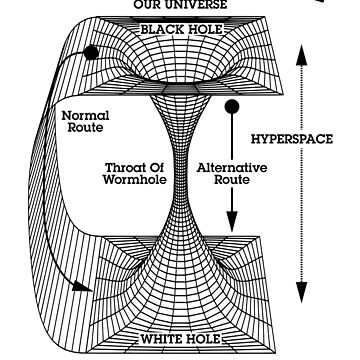
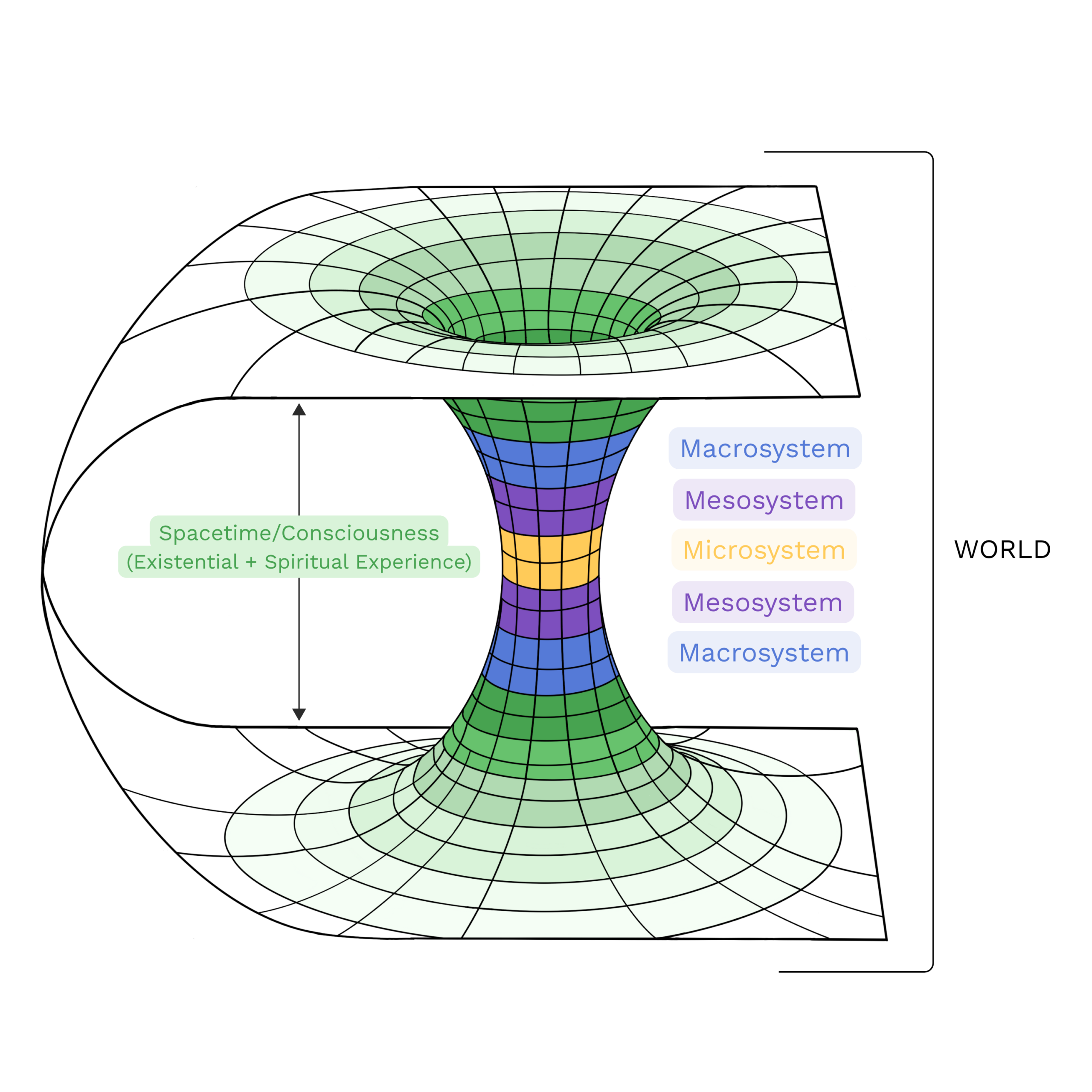
Now imagine that every layer of the WT model is a constant and dynamically moving process – a bit like a whirlpool, let’s say. And the self that we experience that is arising in this whirlpool is a schema (a specific experience and collection of learned strategies for navigating reality by maximizing safety and reducing pain or fear) that arises in response to being right in the center of our experience of this multilevel dynamic process. Each layer is codependently arising at all times with the layer of our mind and experience of spacetime and consciousness of physics which shapes our experience of them all. And our fundamental orientation to our subjective experience at the spacetime layer is shaped by our existential and spiritual capacities. As opposed to the three-dimensional model we used previously, much more accurate model of what a world is would be similar to modeling a wormhole in astrophysics:
To map a World, we combine the WT model of experience with the conceptual metaphor of a wormhole:
Copyright of Adam Kadmon, LCSW-S
Our sense of a separate self and experiences of our embodied mind arise as a particular node in this world circuitry. And like a node in a circuit, they can either efficiently process the energy and information flow from the larger world or they can be interrupted and stopped from doing so. What usually stops our ability to efficiently process and move energy and information through the circuit are traumatic experiences which fundamentally change our experience of the entire world itself. Our node in the circuit either becomes overloaded or is forced to block the dynamic flowing process of information and energy for the sake of our survival. As we found earlier in the example of C-PTSD, the subjectivity, perspective, and agency of the person in that world are profoundly coherent and maximally efficient for survival and adaptation to the world. Our experiences of fragmentation and dissociation (such as having many protective parts or Inner Child parts that need lots of help and love to integrate with our adult self) require us to journey to the worlds they are still trapped in if we hope to heal and be free. These journeys can occur via different avenues in various kinds of experiential therapies for healing trauma. What they all share is some way to access, process the unexperienced experience of the traumatic encounter, and to update emotional learnings and strategies for existing in the world we live in as adults now. In essence, they all provide a means for those lost parts in these old worlds to be rejoined to our current environments and worlds we are in now. We experience a version of spacetime travel to different worlds of our past when we are triggered into some kind of flashback experience. Those worlds become overlayed on our current world in a myriad of confusing and disorienting ways. We are fragmented in our experience across space and time. This is precisely why many people describe their experiences with Complex PTSD as confusing, terrifying, and like they are going “crazy”. In WT, it is this experience of fragmentation across space and time which is the heart of the inner experience of trauma. And they are highly pervasive in our mysterious and misunderstood experience of mental health challenges with depression, anxiety, and a whole range of other “disorders”.
In the experience of a world, our normal sense of space and time can be radically altered when we are feeling sensations or emotions related to the traumatic experience of isolation, aloneness, and the panic of annihilation. Our little circuit has been shutdown and shut off from the exchange of overwhelming information and energy from the larger environment. And we are now re-experiencing the unprocessed and unexperienced energy and information flaw that was transferred to us during the original traumatic experience by the environment. But if we only understand this (as it is typically done in most approaches to trauma healing) as a temporal process of a flashback, we miss a fundamental insight of astrophysics that time and space are not separate but part of one continuum. In WT terms, if this is the case with the nature of reality itself, why would it be any different with our subjective experiences of the world and how our self is shaped and constructed? WT prioritizes spacetime, and not just time, as the fundamental site were wounding, alienation, and isolation occur. And it is in these deep layers of our experiences of spacetime where healing can be most impactful. It is precisely these layers of our consciousness and experience where the existential and spiritual aspects of human subjectivity become paramount.
In every experience of a separate self that generates anxiety and depression, for example, WT would prioritize an exploration into the schemas that have made those protective parts of us necessary for a given time in our life. But WT also would seek to identify the experience from the inside of the suffering self through exploring the entire continuum of spacetime and all the varying levels of systems within that given world where anxiety or depression are necessary. In a sense, we aim to understand the entire codependently arising world of anxiety or depression if we seek to heal and be liberated from it. For example, if I have an experience of anxiety that primarily originates in the need to prevent being attacked or judged by others or my family members, I can also discover how that schema was also emerging out of whole world where others such as my family members were shaped by historical events, politics, economics, or intergenerational traumas specific to the microsystem of the family. My anxiety may not just be specific to my experience of my family or peers but also include the specific culture and economy of the place with all its specific structures of oppression and marginalization related to race, gender, sexuality, orientation, etc. where I developed the schema. Or things like the state of technological development and geographic location where I learned a particular schema to be most adaptable and efficient at surviving in that specific place. And I would also be most interested in the layers of existential and spiritual experience that are congruent with what it is to be anxious.
In my own experience of these forms of suffering, many of my schemas are not just developed from a specific family system which has been intensely engendering for Complex PTSD and insecure attachment throughout my early life. Those schemas are also profoundly based in the highly individualistic and workaholic culture that is characteristic of growing up in an economically depressed small town in the Midwestern United States in the late 20th Century. And there are many of my seemingly-unique schemas that have developed to navigate a world based in complex attachment trauma that are revealed to be profoundly shared with the worlds of many others when we dig deep enough into the bedrock of our foundations. Almost without exception, we share schemas that are ontological in nature. They relate to the foundational nature of our being itself and a separate self that is constructed to operate in a universe and reality based on those schemas (i.e. our world). In the worlds built on trauma where protective isolation and shutting off our circuits from the environment to survive, a few examples of tragically common schemas include:
- I do not deserve to exist
- I am inherently unlovable
- There is no meaning in the universe
- I am responsible for other people’s emotions, happiness, and/or staying alive
- People are not safe
- The world (i.e. a specific world) is not safe
- I am worthy of hatred.]
- I am a mistake
- This feeling will last forever and I will never feel differently
- I am trapped here and no one will help me
- My pain is too big for me to feel and survive it
- I will always be alone
For myself, many of my clients, and my fellow travelers on the healing path, these trauma-based beliefs are the foundational building blocks of what we call Complex PTSD. They form the very architecture of traumatic devastation. Despite the unimaginable pain they cause, they serve as unimaginably powerful blocks to healing and are very difficult to uproot. This is because believing them is the lesser suffering compared to the unconsciously-held sensations and emotions of the traumatic experiences they co-depedently arose with. A child making sense of their experience through believing they are a mistake, unworthy of love, and not deserving to exist because of the energy and information being circulated into their tiny nervous system from the environment is intolerable. But to experience the pain of the wound the belief arises from is absolutely intolerable. The schemas we develop to deal with or avoid this intolerable pain and terror form the laws of emotional physics which govern the worlds of Complex PTSD and developmental trauma. These beliefs, which generate enormous anxiety and depression, still feel relatively workable compared to the original pain of our lives. The most important element WT offers is a way to see that our most fundamental schemas of self, spacetime, and how we experience reality itself are related to these beliefs and experiences. And more so, they can be accessed, reshaped, and transformed through practices such as experiential therapy, meditation and spiritual disciplines, and psychedelic journeying and other altered states of consciousness. Because these foundational beliefs are specific and strategic responses to core emotional sufferings, the original pain will remain trapped in our nervous systems and experiences as an isolated circuit cut off from the world until it can be faced and experienced fully. The alienated, isolated world of the individual will remain as such until these schemas and their associated unexperienced sensations, emotions, and images or pictures associated with those experiences can be accessed and transformed.
This experience of being trapped in this traumatizing world of the past is frequently referred to as “The Void” or encountering an internal black hole. The feeling of being drawn into a singularity of which there is no escape is often the greater suffering than our anxiety, depression, or even desire to destroy ourselves. This is why the use of metaphors from astrophysics such as black hole or wormhole when in Complex PTSD emotional flashbacks (or “shame spirals” as many people call them) are so common, powerful, and useful. They point to the very real subjective experience of the warping of spacetime and being torn apart in a singularity which is felt directly in the body and mind from complex traumatic experiences. This fracturing and warping of spacetime is precisely what WT aims to make explicit and to provide a comprehensive framework for working through it. Encountering “The Void” or being lost in shame spirals as a protective response are primarily what we experience when the core traumatic material trapped inside the circuitry of the self is encountered. This core traumatic material defined the world of our experience when it first occurred. It was totalizing, overwhelming, and inescapable. In the aftermath of the emotional catastrophe, we spend the vast majority of our energy and time trying to protect ourselves and keep dissociated and repressed this core traumatic material. Most effective experiential therapies for trauma help make this unprocessed material explicit and then process it in a safe, trusting relationship with yourself as an adult and/or the therapist. With this safe and trustworthy connection, we can experience deep disconfirming experiences of those original beliefs. They can transform and heal the core emotional learnings guarding the unprocessed traumatic material trapped inside the lonely, isolated circuit that we feel we are. And these new updated learnings reverberate throughout our experiences of the world when we are in groups, communities, and intimate relationships with friends and lovers. We are now operating in the world of the here and now and feeding back information and energy from this new state into the worlds of others. But while there can be relief and healing from being in these relational contexts, WT’s view is that the most radical and transformative ways to disconfirm these learnings and protective schemas occur in the layers of spacetime and the self. In the end, it is in these layers of our specific worlds where our lonely, isolated circuit first shut down and closed itself off to the world to survive the massive energetic influx from the traumatic experience.
Crossing the Chasm
These schemas at the layers of spacetime and the self are precisely where the bridge from healing to spiritual and philosophical quest occurs in WT. Spirituality and philosophy are the domains of meaning, wisdom, and the emotional depths of how we understand means to be human. As Paul Tillich once said of religion, they are the realms of ultimate concerns for us. Ultimate concerns are about our deepest assumptions, beliefs, and theories of what reality is, what is the good life, and how do we fit into the grand scheme of all (if at all). In the worlds of traumatic experiences, the most devastating impacts occur at our philosophical and spiritual foundations. Our experience of spacetime and the existential aspects of our humanness are necessarily fractured and fragmented. We no longer experience normative and integrated emotional experiences that are appropriate responses to the world of the here and now. Each emotion is now fundamentally bound up with these core philosophical and spiritual schemas of self which are the very wounds we carry. In some extreme cases, to even feel an emotion strikes at the heart of our worthiness as beings in the world and is coupled with toxic levels of shame or terror. We no longer just have emotions. We have what in Buddhist and Hindu practice are called kleshas or afflictions. These afflictions or defiled emotions which originated in our traumatized worlds of the past are held in the circuitry of our nervous systems, ready to be activated at a moment’s notice. It is these afflicted emotional states which shape the self’s schemas which drive our disconnection and suffering. And while trauma therapies are essential and necessary for healing the specific ways our nervous systems hold afflicted emotions of the past, they stop far short of questioning how the self and world are constructed from those early traumatic experiences in a codependently arising way. In WT, the schemas of self and our emotional and nervous system states are two aspects of one system.
It is through direct experience, such as in meditative practice or in psychedelic journeying, which has the greatest potential for healing the deepest layers of trauma and accessing the self at the level of spacetime. For example, in experiences with psychedelic molecules such as psilocybin or MDMA, we can encounter the ground of our being directly as open, loving awareness or the Self from Internal Family Systems. In these non-ordinary states of consciousness, we can orient our sense of self as an isolated and fragmented circuit still stuck in the world of trauma in an entirely new way. It is through direct experience of the world and reality itself from this state of open, loving awareness which brings the potential disconfirmation of the entire world of trauma and isolation. This compassionate and wise awareness is experienced as indestructible, ever-present, and not able to be touched by any amount of trauma one has suffered through. It is a kind of metaphysical disconfirmation to find a place inside yourself where the limitations of spacetime and core beliefs and schemas that define your world from unmetabolized trauma are suddenly seen through as limited by the emotional states they arose from. You realize directly that you and the world are not what you thought they were. As a client of mine once said when working with MDMA to face their core terror from childhood trauma and Complex PTSD, “I had no idea you could think differently”. The entire construction of your world is seen through as being constrained and shaped by the terror of abandonment and destruction by others which is and was immanent at all times. More often than not, this is a smokescreen for our was. Every moment of anxiety, shame, depression, and isolation throughout your life were just masks, the only realistic remedies, for being trapped in an unsafe world not of your own choosing. That terror of other people was the echo of a world of terror that had long since lost its name and voice. Or (more likely), a world that we had no choice but to forget. Terror constructed that world from the ground up and the only way to survive it was to ignore, deny, and no longer remember the terror that generated it as fast as possible.
Another example from my own experience: the vast majority of my social anxiety and hypervigilance from Complex PTSD began to be healed when, through the use of Zen meditation practices in combination with psychedelic molecules such as MDMA, I began to see through my schemas of self built upon that social anxiety and the godlike-power they possessed. I was given the gift of seeing that my world of terror was not current but was an active projection of my mind onto the world of the here and now which was being constantly constructed through the schemas of my self and others. Their job was to ensure I never faced the terror and pain of my past all the while never letting me forget it with every moment of being socially anxious. These past experiences with peers and family members required being socially anxious and hypervigilant in a doomed attempt to control the world and prevent being attacked and rejected. I would experience such on-the-surface mundane experiences as going to the grocery store or sitting by a pool with others as life-and-death level threatening to my sense of self. Every breath and encounter brought a new potential to experience the metaphysical destruction of those schematic beliefs of “I do not deserve to exist” all over again. While my experiences with IFS and Coherence Therapy were essential to help transform my emotional learnings of social anxiety which felt necessary to be safe around others, it was MDMA, psilocybin, and Zen meditation practices which most radically brought to my attention that this world I was so terrified to exist in was the world of the Inner Child and Inner Teenager I carried inside. Until I received the gift of seeing through direct experience, I did not realize I could experience the world differently. Hidden in the deep layers of spacetime and the existential mode of my existence, the schemas of my self from my past world exercised total sovereignty during these flashback experiences. I did not even realize that parts of me were still living in the world where connection with others brought terror, pain, and the sting of the arrows of annihilation and abandonment. Every experience of social anxiety primarily protected me from facing the core unmetabolized energy and information of what it felt like to be hated, being treated like a mistake, and violently excluded and rejected in my experiences of family and school environments throughout my life.
In these examples and countless others from my own experience and clinical practice, it is not just that we transform and update an emotional learning of “people are inherently unsafe” or “we cannot survive rejection and loss again”. While this is crucial for healing, it is at the level of existential and spiritual experiences updating emotional learnings reverberates the loudest. Updating emotional learnings creates a gate into the self being reorganized and shaped in new and adaptive ways to the current world. This new self is one that can no longer be abandoned in the way we fear most and can withstand any amount of rejection. This self is no longer built upon a world that shaped it as a fragile, worthless entity to begin with. In short, this new self does not require social anxiety to exist. This transformation occurs primarily because the unconscious material which continues to structure the self as a tiny, fragmented, easily destroyed entity in a terrifying and unpredictable universe is made explicit and metabolized. By metabolized, we mean something related to but far more expansive than just “processing” an emotion. Metabolizing allows us to access the core information and arrested energy of the prior world for organizing our world and self at a higher order of functioning and truth. We learn the truth of our past experience fully for the first time. This truth is what allows us to reorient to the world of the here and now. And this in turn opens the doorway into the spiritual and philosophical realm where we start questioning how much our self, our thinking, and our experience of reality are not what we thought they were. They are not quite as rigid or black and white as our deep emotional and somatic states structuring the self might tell us they are. And more so, it means that the world we exist in is not quite what we think it is, either. We see directly that our unmetabolized emotions and past experiences structure the world of our experience on a mostly subconscious level. We begin to see that our experience of the now is a only constricted part of a vast shared world that has mostly existed in the past. As a quote I once discovered put it: we can return to the past anytime we want but no one lives there anymore. We are haunted by this long lost world which our self was born from. We also find ourselves continuously pulled back there every time the sting of the original traumatic experience from that world echoes in our nervous system. In WT, this fall through a wormhole, the tear in the fabric of spacetime, to the past world is the definition of an emotional flashback.
In The Developing Mind, Dan Siegel proposed that what constitutes a “mental disorder” or mental health issue (take any number of diagnoses like anxiety or depression here) is when there is a lack of integration of the brain which arises from our experience of our mind and the world. This fragmentation blocks and disrupts our ability to maintain both the individual functioning of differentiated parts of the brain while at the same time retaining the linkages between each of them. In Siegel’s IPNB view, mental health requires a relationship with boundaries between various aspects of my brain and world without dissociation between any of the elements either. This insight is especially important in trauma healing work as dissociation tends to be the core issue in our schemas of the self based in survival. Integration and boundaries between differentiated parts of our experience, mind, or nervous system maintain our experience of our world in the most adaptive and responsive way available to us. There is both sameness and difference operating an in integrated fashion across all levels of our experience of both our internal and external worlds. In a recent article on mental health and IPNB, Siegel postulates that when we experience this integration at a very deep level, we gain access to what he calls the hub of the Wheel of Awareness. When we experience this integrated state at the center of the wheel, we have access to the feeling of connection to everything and the timeless quality of some spiritual basis of reality (call it God or whatever we choose). In WT terms, Siegel’s conception of “being in the hub” is precisely the state of consciousness we experience; we see the heart of our experience is codependently arising in every given moment. In this state, Buddhist philosophy would say this is where we experience both wisdom (seeing reality as a process of codependent arising or non-separation) and compassion (feeling and responding to ourselves and the world from this experience of codependent arising). In Buddhist or spiritual philosophy terms, we have seen through the useful illusion of the self/other dichotomy. There is no longer a subject (me experiencing something) and object (the thing I’m experiencing). There is just codependent arising from this open state of timeless awareness. WT states that it is not just the self/other dichotomy which breaks down. We break down the self and world dichotomy which we experience with intensive rigidity in the aftermath of complex and developmental trauma. This necessary rigidity of self/world is why and how WT focuses on the core schemas of the self in traumatic experiences so specifically. The necessarily rigid self/world dichotomy is the main location of our attention and intervention in WT. Our praxis is to cultivate a perspective, a philosophical and nervous system orientation, to the self and world which are not stable, separate entities. WT sees this dichotomy as an artifact of a long-gone world where the integration between spacetime and the world of our experience has been shattered. And the self and its schemas are the key to finding our way back home to integration and redeeming the world itself. It is this bridge from healing to spiritual liberation and freedom where compassion and wisdom become the tools of our world-building.
The Worlds of Heaven and Hell
WT’s central theory and foundation for praxis are its conceptualization of how and why in our individual mind/body/brain development there are certain levels of fragmentation or integration (to use Siegel’s metric for “mental health”) that persist over time. This is not all that different from Yogācāra‘s primary question: if everything is impermanent, how can there be such continuity in our experience and the potential for liberation from suffering that is stable and lasting? In the trauma healing world, IPNB has made a great leap forward by moving the basis of things (especially the self and our mind) from objects to processes. This aligns very closely with the philosophy and psychology of Buddhism, especially Yogācāra’s view on the unconscious river of karma and codependent-arising as the basis of our conscious experience and sense of a separate self. In both Yogācāra and IPNB, the state of our mind, the functioning of our bodies, and the self and its schemas that are in operation at every given moment are constantly changing and dynamic processes. They exist as part of feedback loops which are not static or stuck in place. If we are feeling or experiencing the world or ourselves as stuck at any point, it is a massive indicator that we are not experiencing reality as it is in the here and now. We are experiencing only the protective schemas of self and associated worlds they belong to where stuckness was a key way of making sense of feeling powerless, helpless, and without agency in a world. In the depths of the void of those experiences, being helpless and afraid seemed to be everlasting because, in fact, they were. In IPNB terms, we are experiencing a high state of fragmentation due to being in a high state of sympathetic nervous system arousal so we can survive. In Buddhist psychology terms, we have stepped into the hell realms or Narakas.
In WT terms, we start from these conceptualizations from IPNB and Buddhist psychology but fragmentation is an indicator of something a bit more specific than just the IPNB model of energy and information flow. It is a sign that we are experiencing more than just a lack of integration or fragmentation. It means we are experiencing a block in our ability to metabolize our experience in a way that allows us to stay integrated. More than just a simple process, our experience of our world is primarily governed by how much information and energy from the surrounding environment is able to be metabolized effectively. Metabolism is usually defined in biology as the total chemical processes by which an organism is able to sustain life. These processes usually involve a constant process of creation and destruction of protoplasm in the cells which creates energy for the body. Essentially, we take in energy in one form and our cells convert that energy into another form which we use to sustain our bodily processes and life. In WT, the circuitry model of experience (the total process of self, nervous system, and surrounding environment) goes further than the IPNB view that we are just exchanging energy and information. WT’s circuitry model sees our experience of the world as primarily a process of metabolism of that energy and information. When we cannot metabolize the energy and information coming in from the environment or attachment figures in our world effectively and efficiently, fragmentation of our bodies, minds, and spacetime itself occurs. A wormhole is created where we can fall into that old world at any moment where the unmetabolized information and energy is touched or activated.
In Complex PTSD and long-term developmental trauma, one way to describe the impacts and what happens inside of us is that we can no longer develop in a linear and integrated way as human beings. In trauma therapies and other healing modalities, most of our experiences of suffering are identified as parts of us being stuck in prior developmental stages. These parts or unintegrated neural pathways (in neuroscience terms) are unintegrated into our whole functioning organism and we are plagued by “amygdala hijackings” or emotional flashbacks to past developmental stages with ruthless frequency. We can no longer respond to the world appropriately and with all of our options available so we can meet our needs and face threats in the environment effectively. When this shutdown of metabolism has occurred because of the intensity of information and energy flow in the circuit, it is primarily because of our bodily and emotional responses to that energy and information flow (or the lack thereof in cases of neglect). The associated hyper-stimulation of the nervous system by that information and energy flow creates enormous pain and overwhelm which our systems are not able to fully control, metabolize, or integrate. In WT terms, this experience creates more than just a state of arrested development. It creates a subjective experience of spacetime shattering into multiple worlds that can coexist on top of each other. This is especially heightened when there is a feeling of aloneness and isolation when indigestible information and energy are flowing into our circuitry. This state of aloneness, (which is the core focus of healing in experiential therapies like Accelerated Experiential Dynamic Psychotherapy {AEDP}) is often the core of our traumatic experiences. This traumatizing aloneness occurs when the need for a more safe and developed nervous system, such as from a trusted and safe parental figure, to help us metabolize energy and information flow is not present. Traumatizing aloneness is especially devastating in our earlier periods of life and development where co-regulation with a safe caregiver is most necessary. We need a safe and trusting adult to assist and scaffold us into how to metabolize more intensive information and energy while staying integrated. In Winnicott’s terms, the baby-mother matrix breaks down. In WT terms, developmental trauma is an experience of not having a sufficiently safe and developed auxiliary nervous system to assist us in expanding our metabolic capacity as one node in the entire circuit which makes up our world. In other words, the rest of our circuit has been either too much or not enough for our metabolic capacities to develop effectively.
Echoes in the Body
For those of us who have survived such cataclysmic aloneness in our developmental years, nausea and disgust are frequent indicators of how we centralized our experiences of unmetabolized information and energy in the body via the stomach. Unmetabolized information and energy quite literally stay in the body until the required safety and auxiliary nervous system capacity is in place. Upset stomachs, overeating, lack of appetite, etc. are all examples of the way our digestion becomes disrupted when energy and information flow have been too much to metabolize. Is it any wonder why we frequently talk about our experiences with descriptions of digestion, devouring, or being devoured by others when attachment trauma surfaces in our language? Or why those of us who have experienced the horrors of being an object to be used and exploited by narcissistic parents hell-bent on enmeshing with us would be most afraid of being devoured by an other in a close, intimate relationship? In these experiences, we have faced the life-or-death feelings of massive overwhelm of emotions and bodily sensations that appropriately arise when a parent enmeshes with us and destroys any sense of boundaries or safety for a self that can be integrated and still connected to the world and others. In these cases, we have necessarily associated intimacy and connection with being swallowed and devoured by the other. We carry the unmetabolized information and energy of what it felt like to fuel an adult’s own unmet needs and lack of integration.
It is a common occurrence for myself and my clients that when we begin unlocking the traumatic information and energy from our past worlds, we start to gag, cough, and dry heave. The body communicates to us directly the exact nature of our abandonment and isolation. Our nervous system attempts to vomit up the poisonous or overwhelming energy and information which is an appropriate response. We must expel it out of our system (just as we would with toxic or harmful energy in the form of food) or it will cause intensive pain and even death. Why would our metabolic processes with emotions and attachment relationships with the world around us be any different?
In my own experiences with MDMA and healing my early attachment trauma, I discovered through my body and digestive system the true existential and spiritual nature and cost of my own complex trauma. During the first 3 hours of this (eventually) transformative experience, I spent the majority of the time dry heaving and experiencing intense nausea the likes of which I have never experienced before or since. I was baffled and terrified. Eventually, I realized I must accept that this may be the entire experience or there would be no potential to at least understand it if I did not stop fighting the sickness in my gut. Almost immediately, I fell to my knees in pain and surrendered as the dry heaving crescendoed. Then insight dawned in my body and mind with fiery grace: I was attempting to vomit up the entire world of my parents and my whole childhood environment that was poisonous and toxic to me. It was this world I had no choice but to swallow to survive which had been the hot iron ball in my throat which caused all of my anxiety and depression throughout my life. If there was going to be a road out of this hell realm of the past, it would require more than just healing depression or anxiety. It would require an entire existential and spiritual deconstruction of the world I existed in. For myself, I found that the only way to repair the fabric of spacetime was to purge the entire past world of my parents and environment literally from my body and stomach through action and behavior. What came after those torturous three hours was uninterrupted feeling, screaming, fighting, protecting, weeping, and dancing my way back through the gates of the underworld.
In WT terms, when we swallow the past world to survive complex and developmental trauma, we must organize our circuitry around feelings of numbness, dissociation, and alienation out of necessity. When we carry unmetabolized information and energy from our traumatizing experiences, we carry the whole world of that trauma where aliveness, connection, and positive emotional states were not possible or not accessible. When we have swallowed a world, our nervous system will stay in states of hypoarousal (depression, dissociation, numbness, and suicidality) to stop us from the intensive hyperarousal (anxiety, panic, and addiction) of the past world. The remnants of this overload lead to the complex trauma hallmark of “feeling dead while alive” and being able to live in one’s own body after the experience. Depression, numbness, and dissociation are some of our most valiant protective responses for this very reason. The information and energy of the past world is the very fabric of the life-and-death level threat we carry at the heart of Complex PTSD. We faced this initial overwhelming experience without any feelings of power or control to protect us and help us feel safe and worthy of existing when they occurred. This unmetabolized material is the heart of all emotional flashback experiences. Each flashback experience is in itself a world which we experience when anything in the here and now even remotely mimics the past world where the information and energy originated from. This information and energy (i.e. the past world) will remain with us and the wormhole to the past will remain open until we have the internal and external resources to integrate. Integration does more than just maximize our ability to respond adaptively to the environment in IPNB’s terms. For experiences of hypoarousal, shutdown, dissociation, and fractured spacetime in complex trauma, integration is a sign of how much repair of of the spacetime continuum we have accomplished
The self we were forced to construct to adapt to the world of complex and developmental trauma does not have the capacity to experience, metabolize, and integrate this information and energy of the past world. In Winnicott’s terms, the false self was designed for survival – not for living or relating. This survival-based self feels fragile, easily destroyed, or worthless and without agency. In the world of trauma, this is quite adaptive and coherent. There was a reality to this experience which makes these feelings coherent and understandable. However, when we are in the presence of these familiar feelings of impending doom now, we can follow Pete Walker’s lead and see these as evidence (and eventually proof) of the past world we carry inside of us. It is not the self which is flawed and fragile. It is the residue of the world these feelings codependently arose in. This world did not provide the necessary internal and external resources to metabolize and integrate to the feelings and flow of life within our circuitry of mind and self. What else is a mind and nervous system to do in this experience but brace, armor up, and wait for inevitable destruction?
The Limiters of Survival
All effective experiential therapies for trauma provide a means to metabolize traumatic information and energy by identifying it as the outside world of our experience, not our core sense of self and inherent worthiness as a being, that was the source of our pain and terror. In other words, they all undo the need for shame and to identify ourselves as the reason for the calamities that befell us. Shame’s primary function is to establish the illusion of control when there was, in fact, none in our traumatic experiences. We metabolize the content in a way that was not accessible in the original experience when we have access to a safe and trusting connection with another nervous system (parent, therapist, friend, lover, community, teacher, etc.) and a sufficiently-developed internal capacity to hold this intensity of energy and information. When these are present, the coherent need of going to shame and self-blame as the only way to protect ourselves from it is no longer required. In WT terms, shame and self-blame are the primary mechanisms by which our circuit is closed off from the rest of the world to protect the integrity of the system and prevent collapse. They are the limiters in the circuit which we use in our desperate attempt to protect the nervous system and mind from being shattered beyond any repair. Isolation and separation are the price we pay to protect ourselves from the overload of information and energy coming in from the rest of our circuit and the world.
The limiter function of shame in our circuitry relates to a core insight from trauma specialist, Janina Fisher’s, model of Structural Dissociation on how we become fragmented into different parts. In the Structural Dissociation mode, when trauma occurs we fragment into an “apparently normal self” and a “traumatized parts or selves”. When this occurs, the fractures in our personality and brain functioning are papered over by trauma-based beliefs. We rely on trauma-based beliefs to manage the overwhelm of our circuitry from the world information and energy that is too intense to be integrated smoothly and maintain our functioning. Our minds utilize this ingenious capacity to generate trauma-based beliefs to maintain some level of functioning of our circuit at all (albeit in very wounded and detrimental ways) as the lesser suffering to being totally destroyed. These trauma-based beliefs become the locked doorways to the very unmetabolized information and energy of the traumatic experience we desperately need to metabolize to resume our connection to the world of the here and now. As long as they remain locked, we cannot resume the flowing in of new information and energy for healing from the world back into our circuitry and contribute information and energy to other circuits in the world.
These beliefs are precisely the core learnings of shame, self-hated, self-blame, unworthiness to exist, or inherent unlovability we identified earlier in the schemas of self in Complex PTSD. These beliefs maintain the integrity and functioning of a self that arose from the experience of trauma but also lock us into believing the world we exist in now is defined by the trauma of our past world. When the trauma originally occurred, it was the world and ourselves which were codependently arising based so it makes complete sense this would be the case. But if we want to reconnect to the world, to find our way back home to being a jewel among jewels in Indra’s Net, unlocking and walking through these doors of trauma-based beliefs is the only way. The only way home is through the gates of hell itself. We must face the minotaur at the center of our own dark labyrinth. But in this trial of the soul, we can rest assured that death has no dominion here. In the end, the monster inside of us we fear most is simply what has already happened to us.
The Worlds of Emotion, Mind, and Language
Before going further, we will summarize WT up to this point. WT frames our experience of what happens inside of us as a result of trauma as a wounding which tears and collapses the spacetime continuum in our subjective experience. These tears and collapses lead to experiences where multiple worlds (i.e. points in specific spacetime locations) can exist at the same time. The rupturing of the spacetime continuum occurs as a consequence when energy and information flow from the environment and other nervous systems are unable to be metabolized by our minds and nervous systems. This occurs from energy and information flow that hits us (in Somatic Experiencing terms) too fast, too much, and too soon. the basis of healing and integrating what has been fragmented requires metabolizing unexperienced information and energy from traumatizing experiences which have overloaded our circuitry. This overload has shattered our subjective experience of time and space. This has dramatically altered our ability to process and integrate experiences of information and energy flow into our circuitry. Our node shuts down, shuts off, and begins to exist as an isolated point in spacetime. In this experience, we primarily (not only, of course, but primarily) exist in a world of the past environment and conditions where the shutdown and shutoff occurred. Our schemas of the self and mind (where the very construction and meaning of the self occurs) continues to exist in the prior world. The construction of a new self and schemas are shut off and disconnected from receiving new information and energy from the rest of the world right here, right now. This will continue until the fragmented past world’s information and energy can be metabolized. This information and energy can then be utilized for work and greater coherence of the entire circuit (our mind, nervous system, and attachment relationships to the environment) that is reunited with our adult self and body. When this occurs, the jewel opens back up the gates to the world and finds its way home.
The entire thrust of WT is to help us move through the models of learning and models of inheritance described previously. Beyond these two models, we can move through a model of metabolism for traumatic information and energy and return to a model of reflection as our orientation to reality and our world.
In WT, moving from metabolism to reflection requires us to face the core traumatic beliefs and emotional learnings which have protected our circuitry from complete destruction and fragmentation. These beliefs structure and reinforce the schemas of self that arose in the codependently-arising conditions of the world that traumatized our circuitry in the first place. It is a great irony of healing that the primary blocks to reintegrating our circuit with the world of right here, right now are the very gates to rejoining the Net. Shame, fear, hypervigilance, etc. function as the gates to past worlds through showing us directly through feeling and sensation the schemas preventing these very feelings of safety. These feelings are indicators we are approaching the wormholes to the past. It is only through entering these wormholes that we can find the parts of us are waiting to be found inside them.
The traumatizing worlds of the past could include any combination of our family, school, community, religion, political and economic system, globalized political situation, or even environmental disasters and catastrophes. WT states that the ways our environment impacts us, how our self arises as an emergent property of codependently arising conditions in that world, and the protective mechanisms of our circuit in that world are relatively shared among all beings with minds and nervous systems. While each being experiences a unique combination of codependently arising conditions, there are a relatively limited number of ways our minds and bodies protect us and keep us alive from overwhelming information and energy exchange. These ways are shared among all beings with minds and nervous systems. WT offers a way to map and integrate both the universal and the particular into a single soteriological framework. It bridges our unique experience of fragmentation and how our circuit functions based our world conditions of spacetime with the shared, universal forms of self, cognition, and information and energy exchange we all possess. Just as Buddhist philosophy seeks to hold both the conventional and absolute realities in one practice, WT seeks to hold the individual and universal truths of our experience in one soteriological metatheory.
Based on this framework, WT has its own ways of understanding the specific challenges and sufferings that arise from carrying unmetabolized information and energy from past traumatic experiences. And these in turn can provide guidance on how to find the lost parts of us stuck in our past worlds where the keys to our suffering reside. Essentially, WT is a tool for mapping and guiding rescue operations for the parts of us that are lost in the hell realms where they still live and suffer. It is a way to hone in on the beacons of the past worlds present in our experience and guide ourselves to the roots of where our suffering resides. As part of its mapping focus, WT also provides certain ways of conceptualizing the components of healing and spiritual practices. Let’s explore some of those now.
Emotions
Where we decide to build our philosophical home carries enormous implications for how we define things. A common definition of emotions in psychology (and assumed in experiential therapies like Coherence Therapy and Somatic Experiencing) sees them as signals that relay important information about your needs, values, and overall state of well-being. Each emotion is tied to specific bodily sensations and states of nervous system arousal. They move and communicate signals from our bodies to our minds at incredibly fast and efficient rates, especially compared to our prefrontal cortex’s cognitive processes. Emotions provide us with rapid information and options for how to interpret and react to threats in the environment. Our work in healing and therapy requires us to become educated in the ways specific disruptions of needs being met or not met by the environment are primarily understandable through our emotional life. Most of my own healing journey and with my clients has been built on greatly increasing our emotional intelligence and wisdom so we can understand how the body and emotions are not just worthy sources of information about your experience – they are primary.
This is especially the case for any childhood trauma survivor and/or anyone in a larger social and cultural world which actively undermines and punishes the expression of spontaneous and genuine emotional expression. When behaviors and responses those emotions are prompting us to do in response to the environment which is threatening our survival or not meeting our needs, we can and should expect anxiety and depression to result. These are coherent survival responses to a world where your needs and emotions are not validated and listened to as worthy sources of wisdom and action. WT takes as a common part of our shared world conditions the familial, social, and political forces which socialize and train us into repressing and suppressing our primary emotional responses to our environments. Our contention is that emotional neglect and abandonment are a hidden plague contributing a great deal to our widespread experiences of trauma and a major root cause of many major mental health challenges and the epidemic of loneliness in the United States. There is no greater catalyst for isolation and loneliness than individual and widespread emotional neglect of ourselves and each other.
Along with Pete Walker, we agree that emotional neglect alone is sufficient for creating the experience of Complex PTSD and meeting all the major criteria of traumatic experience. While our sole focus here is not on implications of emotional neglect for political life, WT’s view of the layered systems of our worlds have enormous implications for political ideology and action. In WT, every political view is emerging from schemas of the self and as part of the world circuitry of our subjective experience. There is no political perspective which could not greatly benefit from understanding how our bodies and nervous systems in these conditions of widespread emotional neglect lead to codependently-arising political perspectives and actions or the lack thereof in the world. In my own experience, we often seek to change the entire world rather than face the terrifying unmetabolized information and energy held in our circuitry. And who can blame us? Our first experiences of social oppression, exploitation, and violence come within our most intimate connections with our families, caregivers, and peers. It is quite coherent that we can both be radically driven to make our worlds a more just and safe place all-the-while attempting to resolve our own traumatic experiences and metabolize the information and energy from them via an external means. The first is a noble calling that myself and countless others have dedicated our life to. The second, on the other hand, is a less noble or effective one that I and many others have been trapped in completely unconscious of what we were doing.
To return back to the individual system level, how we define emotions and their place in our experience largely determines what we think healing is. WT’s focus on experiential therapy leads to specific implications in how we resolve this social dilemma of emotional neglect and abandonment as a personal and political problem. In Somatic Experiencing focuses on how unmetabolized emotions are tied to a larger bodily experience of our survival responses being thwarted and unable to be accessed in the moment. These thwarted survival responses (such as not being able to escape or fight back when I was under threat) and their associated emotions are the prime suspects for our suffering. For example, if I constantly feel terror and panic of being abandoned by a romantic partner or friend, the most likely place to heal this wound is not in the current experience with the partner or friend. It is in completing the survival response of being able to fight back or just simply grieve the feeling of being out of control of being abandoned when I first encountered the terror of abandonment earlier in life. This is not to say that there are not real reasons to feel this way with our current partner or friend. It is pointing out that the limiting of our responses to our current experience to either anxiety or numbing out and dissociating are likely signs of the long history of this experience in our life.
In Somatic Experiencing and many other experiential therapies, emotions and nervous system states are quite logical and understandable. Contrary to our deepest social and political conditioning from the historical view that mind and body are separate from the philosopher, Rene Descartes, emotions are highly intelligent and inseparable from our rational minds and use of logic. Anxiety moves us out of depression and numbness which are usually there to stop us from feeling anxious and panicky about our current threat level in the environment. Anger resolves fear and panic through establishing boundaries and protecting ourselves from threats. And grief typically resolves them all in a way that allows the information and energy of the past to be integrated through the acceptance and surrender to the truth of our past experience of being helpless and hurt. Grief reopens the circuit to information and energy from the current world.
In WT terms, this is a simple way to say it is easier to destroy the spacetime continuum of our human consciousness than it is to feel the emotions and sensations of aloneness and vulnerability that accompany primary abandonment and annihilation (i.e. core trauma). If our worlds do not contain the conditions for mutual validation, support, and sanctioned ways for emotions, the destruction of our spacetime continuum is quite inevitable. My emotional range in my life now and how much capacity I have to use emotions as a source of wisdom for navigating my world are likely constricted or expanded most by my schemas of self. These tears in spacetime are most apparent and easily accessible (but not simple or easy by any means) through the schemas of the self and how and which specific emotions are felt or not felt, expressed or not expressed. We cannot understand how a tear in spacetime occurs without taking into the account the entire world conditions in which it occurred. And the schemas of the self and the entire world conditions are in the end two aspects of one codependently-arising experience.
While the focus on unprocessed emotions is quite standard now in the trauma therapy world, WT sees a largely unrecognized gap in most experiential therapies for trauma. This gap lies in how healing approaches and trauma therapy have developed a view of the mezzo systems which actively undermine the smooth flowing of information and energy through our circuitry and metabolizing of our experiences. In other words, does our therapy see the codependent-arising of the microsystem with the mezzo and macrosystems of our world? This is the under-discussed “environment” in IPNB’s Triangle of Human Experience. As long as the family, institutions, political and economic systems, or worldviews built on scientific materialism as a whole actively seek to teach us to repress our emotions and vulnerability, traumatic information and energy will not be metabolized. When a specific node in the circuit of the world must repress (through pervasive and destructive emotional and physical neglect or systemic abuse and violence) the wise and necessary emotional responses to those systems, that information and energy will manifest itself as anxiety, depression, and any range of “mental health disorders”. Instead of world that can sustain the healthy functioning of the nodes, there will be an ever-blossoming world that creates traumatizing experiences for human beings as part of intergenerational patterns of unmetabolized information and energy.
WT offers a specific way of asking questions of ourselves and others not just about what our emotions are in response to but when, where, and for how long have those emotions been unmetabolized information and energy we sorely needed in our lives? Essentially, WT’s question about all our emotional experiences is: what world do these emotions belong to? This question is the locus where WT combines both the models of inheritance and models of learning into one model of metabolism which directly points to the core of suffering and unmetabolized experience. These questions are how we echolocate where the sources of our separate self have arisen and what keeps them so firmly locked in place. It is a way of finding where the lost parts of ourselves are in those past worlds so we can bring them home.
WT also allows great depth in how we walk the path between naming what hurt that is happening in the present and what hurt belongs to the past in terms of our emotional responses and pain. This is a key area where we typically struggle most in intimate relationships. Tears in the fabric of spacetime create enormous confusion and difficulty in not falling into the survival-based tendency into absolutist, black and white thinking. The importance of recognizing how our nervous systems can operate in two or multiple worlds simultaneously is paramount if we hope to restore our ability to be intimate with others and ourselves. Intimacy and vulnerability with others requires a great deal of capacity in our circuitry and enormous skill to be vulnerable and open to another’s vulnerable core. As the great German poet, Rilke, said, “For one human being to love another human being: that is perhaps the most difficult task that has been entrusted to us, the ultimate task, the final test and proof, the work for which all other work is merely preparation” WT resonates as much Rilke’s call to “become world, to become world in himself for the sake of another person” as all the therapy manuals on couples therapy and how to be intimate.
In many moments of conflict with our intimate others, rupturing of the relational safety and trust leads to profound feelings of disconnection and aloneness. Our ability to preserve and protect the relational world of the relationship becomes highly clouded by the unmetabolized information and energy of other worlds of the past being blocked, making it seemingly impossible. This goes beyond just feeling “triggered” by a partner or projecting your parents onto someone you are in relationship with. WT states that the eruptions of rage, terror, disgust, shame, or despair are the very gateways to the past world our partner has just graced us with direct access. The only hope of repairing the relational worlds of our present lie in not turning away from the gate to hell you were just blessed with. Only if we can resume the free flowing of information and energy into the shared circuitry can we hope to find our way back. It is quite logical to see how when we or our intimate person avoids their own vulnerable feelings and venturing through the wormhole, we have a perfect recipe for chronic disconnection and loneliness in the presence of another. Instead of two or more stars’ gravity sustaining the system, we have black holes devouring each other and warping spacetime all around them. As a relationship therapist myself, I can confirm that nothing will pull fragmented and lonely partners out of their mutually destroying wormholes than identifying the core fear and sadness underlying all their shame and anger. Coming out of the wormhole to the safety of other stars in your system is as easy as taking a breath after you have been suffocating. That breath lies waiting for us if we can only see all that information and energy of the past world for what it is and become a world unto ourselves, just as Rilke implored us to.
To return to WT’s view of emotions after our explorations, WT states that emotions and the body are the doorway to the bridge between trauma healing and the existential and spiritual dimensions of healing. Emotions, in the end, are primarily about our relationship to our environments and other nervous systems. Emotions provide our most direct access to the schemas of the self that are in operation in any given moment of our experience. When we are most in the throes of an emotional flashback or rupture with a partner, for example, they are an entry point into understanding and deconstructing the past world that we have fallen into. In my work with relationship therapy clients, when they are in the depths of pain and isolation from each other, it is almost without exception some past world’s schema of self which is most responsible for their suffering. That schema is usually built from codependently arising conditions which lead to feeling they do not deserve to exist, I am a mistake, I am too much, or I am not enough. As with other experiences of these ingenious but destructive beliefs, it is in our intimate relationships that we are most vulnerable to the possibility of proving our deepest fears about ourselves are true. But in WT terms, this is primarily a shield against the unmetabolized information and energy stored underneath or behind or within the protective and coherent schema. This is not to say that real pain and hurt in our current worlds is not real or may lead to severing ties and ending relationships. However, healing from trauma is primarily about restoring our ability to either act, change our environment if we can, or leave the environment all together. This is what we could not do in the past world. In WT terms, emotions are the necessary keys to the past worlds of our lives and also to the gateways of our to transform our current worlds, as well.
Boundaries
You are likely to find that any discussion of healing trauma will inevitably talk about the need for boundaries. But what exactly are boundaries and why are they so necessary for healing trauma? And what do boundaries have to do with existential and spiritual layers of healing? WT’s conception of boundaries (or our struggles to establish healthy ones) is primarily a behavioral expression of the state of one’s circuitry and integration of information and energy flow at any given time. And when we struggle with establishing them, the state of our boundaries is a primary indicator of which world we may be living in at any given time. Boundaries are fundamentally connected to our emotions as responses to the environment we are in. Boundaries signal the level of fragmentation or integration our circuitry can maintain with the world without either becoming very porous or hardening into rigid walls. If you are struggling with maintaining healthy boundaries in any way, that is a signal as to where unmetabolized energy and information is to be found. In WT, the question is not how to set and enforce boundaries but what has interrupted our ability to establish and maintain boundaries between self and others that can keep our circuitry flowing and integrated.
Most trauma therapy would define boundaries as sets of rules and guidelines for how to protect yourself from harm from others and what expectations you have for how you are to be treated. When our ability to set boundaries is not accessible (usually for some coherent, protective reason), we most often rely on control and power to do the job for us. In Complex PTSD, that usually shows up as either our Inner Critic and/or Outer Critic taking over for us. These two essential protector parts that arise from the worlds of complex trauma operate primarily on shame and judgment to do their messy but essential work. Jules Taylor Shore in her brilliant IPNB-based work on boundaries has named the importance of protecting you from my mind and protecting me from your mind as part of healthy boundaries. We cannot experience safety and protection with others or ourselves without boundaries being in place. WT takes this Taylor-Shore’s insights as essential and goes a bit more expansive with what we mean when we say protect you from my mind. WT states that boundaries are primarily about keeping you safe from the worlds of my past and keeping me safe from the worlds of your past.
As the mind arises from those worlds, this is where we can cause the most harm to each other without healthy boundaries. We must guard the gateways of the wormholes and tears in spacetime as a primary boundary practice. When we do, we protect the relationship and our current world from the tears in the fabric of spacetime which you or I can fall through any time unmetabolized energy and information is activated. When we do not, we will inevitably drag each other into the tears in spacetime, usually in some desperate, unconscious effort to be helped and rescued from them. For many of us healing from Complex PTSD, boundaries are a primary place of struggle and practice. They are the borders and barriers where our core schemas of self are being activated and potentially changed. This is completely coherent because boundaries (or the lack thereof in our developmental history) are an active, behavioral answer in real time to the question of whether we have the right to exist as separate individual beings and still be loved and accepted. The state of your boundaries are your answer to this question happening in the body and in the intersubjective field.
In my work with my clients on the importance of boundaries, we prioritize diving through the wormhole to find what worlds have they existed in where being a separate, individuated being in their own right has been unacceptable, unavailable, or at worst maliciously attacked and destroyed. In Rollo May’s language, we do this to find where they are still attached by the psychological umbilical cord people and places where unconditional love and freedom to be oneself was not available. For those of us with histories of complex trauma, we must venture into the void to see, feel, and hear where the deepest spacetime layers of our world and our self to actively attacked and destroyed or neglected and starved from developing. When you have real experiences of being shamed, rejected, or even attacked and hated for your very being, why on heaven and earth would anyone not question whether they deserved to exist as their own separate being? And if you doubt whether this actually occurred and was felt by the younger you, simply look at how your boundaries operate on a day-to-day level.
For WT, the importance of boundaries is not just for the sake of improving one’s sense of safety or satisfaction with life. The great tragedy of boundary underdevelopment and/or destruction during childhood lies in the distortion of our ability to develop compassion and wisdom of our fundamental nature as codependently-arising jewels part of Indra’s Net. Challenges with boundaries are signals of where wounding and destruction have occurred on the level of spacetime, existential, and spiritual experience. In some indigenous wisdom traditions, trauma is understood as when the soul has been separated from the body. Porous or rigid boundaries are primarily manifestations of the soul and body being fragmented and divorced from each other. When our jewel has not been granted the dignity and freedom to exist as both separate and unified with The Net by the other jewels around it, there are two primary manifestations of how we must adapt to survive. First, we equate a lack of separateness and individuation with love, connection, safety, and the conditions of your right to exist. This is what is called “anxious attachment” in attachment research. Second, we deny any connection with others or our impacts on them through using walls instead of boundaries. We equate isolation and disconnection with freedom, independence, control, safety. In this “avoidant attachment” style, the only way to exist as a safe and stable jewel in The Net is to be totally separate from other jewels. In either case, too much or too little boundaries show us where and how the existential and spiritual wounding occurred. The past world is present always in our expressions of our boundaries (or lack thereof). They directly point to where codependent arising and interbeing were distorted and destroyed during most vulnerable periods of life.
In WT, either of these boundary struggles (or some combination of both arising based on different circumstances) indicate some core traumatic experience occurred at the heart of our being. In general, that experience is defined by some knowing that we were either vulnerable to being swallowed up and devoured by the world or that we could not maintain shared reality and connection without sacrificing some essential elements of our psychic and emotional selves. In either case, the learnings of these experiences teach us that we are not allowed to fully exist in the world with other nervous systems or as a part of the larger world of information and energy flow. Either The Net devours your jewel or it demands you be some other kind of jewel than you are to be a part of it all. There is no greater place where our terms of attachment in The Net are worked out by godlike forces beyond our comprehension than with our caregivers during infancy.
Too much energy and information flowing into one’s circuit (say, with an adult parent using their child for their own narcissistic gratification or to meet their unmet childhood needs) registers as intensive pain, terror, and threat of annihilation. The amount of energy an adult nervous system generates and can transfer into the circuit of a child is enormous and potentially destructive. This is especially the case when caregivers operate with a lack of their own boundaries and unmetabolized emotion and energy which they seek to offload into any other circuit that can be found. For vulnerable and helpless children, they become an inevitable place to attempt to offload parents’ unmetabolized information and energy (consciously or unconsciously). When this is part of the world they exist in, children have no choice but to shut down their node and construct walls to prevent total annihilation or being devoured totally by the world. Alternatively, if there is a profound lack of energy and information flowing in from the circuit, the devastation of starvation is equal to being devoured. Children need energy and information flow from their world to develop and sustain psychic life. Without it, the desperate need for coregulation from other nervous systems and increased energy and information flow from the world becomes a prime directive. To survive, we will limit anything in ourselves which could lead to what little information and energy flow we receive from being cut off. Never challenging this limited flow of information and energy we need to develop a self and mind comes at the expense of healthy separateness individual being-ness distinct from other jewels in The Net. We then seek to supplement the unmetabolized information and energy from our original starvation with any other source we can find. Most of our desperate and externally-driven needs for validation and feeling worthy in our jobs, communities, and relationships and partners originate in this starvation. The starvation does not just go away. The unmetabolized information and energy creates a hungry ghost inside of us that will never be satiated until the original pain and abandonment of our starvation is faced.
In WT terms, boundaries are fundamental structural components of our schemas of the self. They are precisely what holds together the spacetime continuum of consciousness. Boundaries are what keeps jewels in Indra’s Net able to be both separate and non-separate. With porous boundaries or with walls instead of boundaries, we are doomed to repeatedly fall back and through wormholes into the worlds of the past. Boundaries are both a characteristic of being in the world of the here and now but also a requirement for rescue operations into the worlds of the past. They serve as one of the first places where healing fractures in spacetime occur because they demonstrate that we can exist in the world of the present, not just the world of the past.
Past worlds are defined by the lack of boundaries and balance between separation and non-separation. It is common that when we struggle with boundaries and consistently fall back into a wormhole as we start building a platform in the present world, we feel enormous shame and hopelessness. But in WT’s view, every fall is a fall upward. It is an opportunity to visit the past and find some new way to meet the need not yet met, to protect the child not protected, to love the self which felt unlovable. In other words, we cannot metabolize information and energy of the past which keeps the fractures in spacetime open without the fall. Often on the path to healing, we feel we need redemption for ourselves to counteract some feeling that we are fallen, broken, or unlovable. Our very definition of healing has been co-opted by the protective functions of shame and self-abandonment. For WT, this desire for redemption hints at something essential but it is not because we the self or the world of the now require redemption. Redemptionmust but found for the past itself. As the great Marxist philosopher, Walter Benjamin, knew, all struggles for liberation are struggles for the past and not primarily for the future. Benjamin and Dōgen Zenji both knew that liberation and freedom come first through taking the backwards step into that which lies behind our perception of the now. WT follows suite with them both and sees the project of restructuring the self and our worlds through direct intervention in the existential and spiritual level of experience as redemption of the past. It is through this repairing of the spacetime continuum and metabolizing the information and energy of the past world that we end the necessary dissociation of the now from the past. There is no future but through this redemption of the past which always involves bringing safety, regulation, compassion, and truth of the codependently-arising conditions to that lost self waiting for our arrival.
Here is an example of this process from my own experience with both Coherence Therapy and Somatic Experiencing influenced by Zen Buddhist practice. This experience was deeply informed by John Bradshaw’s Inner Child rescue operation meditation. During an intensely challenging multi-day meditation retreat late in my Complex PTSD healing journey, I found myself unexpectedly face-to-face with all the unmetabolized information and energy from the most acutely traumatic experience of my life from the first few moments of taking my seat in the meditation hall. It was shocking, horrifying, and I felt pinned to my cushion for almost ten hours straight as I was taken directly into the hell realm of my past world. With the help of my teacher and the quiet, stable support provided by the sangha members sitting all around me, I had the chance to face this mind-shattering experience fully and with eyes open for the first time since it happened 25 years before. This event was the single most shattering event to my spacetime continuum and haunted me in most of my experiences of social anxiety and fears of being annihilated by others which could occur at any moment.
In metabolizing the experience, the information and energy left over required more than just accessing my fight response and even more than just grieving. It required compassion and wisdom for myself and all the karmic streams that led my birth parents and myself to be in the situation in the first place. With the help of my teacher, I began practicing giving compassion to all the pain and suffering for generations which led to the entire world of my childhood. After hours of extending this practice to everyone and everything which created that hell realm, I was given a vision. I saw myself now, the adult who could sit in that meditation hall and metabolize this experience in a boat, in a boat with my Inner Child and Inner Teen. I was gently rowing them across a river and away from their terrifying past world. On the bank behind us stood all the people of their world which caused all the destruction and terror in their lives. On the boat, I guided my Inner Children through how to offer compassion for himself, everyone that stood on the shore, and the entire experiences themselves. With the help of my teacher, I could gently teach him what compassion and wisdom meant through seeing the endless streams of karma and intergenerational trauma which lead to the destruction in his life. It also meant I could see how I had learned to perpetuate that very destruction in my own life through his trauma responses and learned responses to survive that past world. On the other shore, we rowed toward all those people, communities, and experiences in our life now which embodied care, love, and true refuge. The river we rowed across was the essential boundary in the spacetime continuum between the old world and the new. There could be no boundary creation and healing spacetime without both a past world and a new world to row toward. The rowing was the healing of the fractures in spacetime.
This example and its Zen Buddhist imagery exemplifies why boundaries are essential elements of spiritual and existential healing in WT. Our challenges with boundaries with self and others stem from these core existential and spiritual levels of wounding. We struggle with boundaries not just from low self-esteem or fears of rejection. These are just symptoms of some larger wounding which has structured the entire world we experience. All too often, we have either had an entire world violently shoved down our throats or have frozen and starved to death from being marooned without any safe world to exist in and nourish us at all. As long as we have no clear demarcation between the worlds where these experiences occurred and some safe refuge to row toward, we remain marooned in the past world. WT’s perspective offers us a way to see through the individual system level of just me and you where boundaries are a challenge. We can see the entire world where challenges with boundaries are indicators of the health of our world and circuitry as a whole system. In the end, healing our boundaries and finding a way to live in both unity and separation in The Net requires an entire revolution and creation of a world. In those new worlds, we can finally feel at peace and at home where boundaries are never questioned as part of our belonging.
Language
In WT, language and concepts are essential to understanding how we shape our worlds and our relationships to what we feel and how we suffer. The relationship between language, healing, and spiritual liberation is a vast and labyrinthine one historically. While it is too big to tackle in its entirety here, suffice it to say that in both the worlds of Western European and Southeast Asian psychology and philosophy, there are abundant common threads for seeing our language as a primary cause of our suffering and afflictive emotions. Language shapes how we feel emotions and interpret reality. We construct our core emotional learnings and schemas which shape how we feel, interpret, and act in the world out of the language of our world’s systems. Most experiential trauma therapies help us organize and integrate unmetabolized traumatic information by shaping a coherent narrative about our experiences where there was once only fragmentation. Prior to healing, unmetabolized information and energy limits the past to either all terrible (trauma), or all good with no pain or issues at all (idealization), or as a blank space (dissociation). We need an integrated, coherent narrative of the past to organize our perceptions of life into one that can hold both good and bad. WT sees language’s relationship to liberation and healing through the view that our schemas are material, not just cognitive. Language in our worlds operates on our state of consciousness as both material reality and a nonmaterial one. The material reality of language shapes our schemas of self which lead to concrete actions and experience in our day-to-day life. The nonmaterial reality of language exists at the existential and spiritual levels of spacetime experience. At this level, language is an expression of our core beliefs of ourselves and the universe as a whole which show us which point in spacetime we are operating from. If we are in the past worlds of trauma, how we use language to describe ourselves and the world will typically be most characteristic of whatever stage of development we were trapped in.
To help unpack the primary place of language use in WT, let us return to the philosophy of Yogacara. Yogacarin philosophers have postulated that our personal suffering is profoundly shaped by our shared language usage and perceptions of the world. Through our shared language use and social conditioning, we carry the same seeds of specific perceptions and beliefs of the self and the world. These seeds create shared habitual patterns of perceiving, feeling, thinking, and acting. The personal and the larger social and cultural systems share the same seeds of perception. This shared world is deeply structured by our shared language of how we define things and it is language which is a primary cause of the experience of having a separate self. Our sense of self-identity (which is our primary intervention point in WT) is not just something we refer to with language. it is made up of language and is an expression of the world of codependently arising meanings from beings with nervous systems that use language. Our self and world are profoundly intersubjective in the Yogacara perspective. WT shares with Yogacara a primary focus on how the self and our worlds are constructed unconsciously through our shared language. It is constantly operating and binding us into shared perceptions and experiences of our consciousness with other consciousnesses. WT emphasizes this Yogacarin view of language in combination with viewing the materiality of language as arising from embodied beings with nervous systems from the trauma healing world. In WT’s combined view of trauma healing with existential and spiritual experience, our worlds of language are profoundly material and arise out of our embodied experience. In particular, it is the state of our nervous system being in a state of safety and regulation or survival which has the most influence on our language use. Our nervous system state shapes how we describe our sensations, emotions, and the images and metaphors. It is not just that “story follows state” – it is that language and world follows state.
WT provides a crucial missing element to the Yogacara view from Western psychology and philosophy for understanding how we can be so thoroughly mired in collective delusion. In the previously cited work of Mark Johnson, he explores how the cognitive structures and shared language we use are all primarily organized by the mind’s use of imagination (which is an embodied and material thing). For Johnson (and we would offer most spiritual practices and philosophies such as Yogacara), there is no split between the material, embodied world and the rational, cognitive structures of our mind and thinking. WT’s primary foundation shares this view with Johnson and Yogacara of nonseparation between mind and body. A world is not a material thing nor is it a rational or conceptual thing – it is both. WT’s emphasis on language emphasizes that how someone uses language to describe their world is a direct expression of their material experience of that world. Those material conditions construct our language as solidified and shared ways to name and express the material reality. Here is where our intersubjective language we use to express the felt sense of what it is to experience the circuitry of their minds and environment collectively is a shared condition of our reality. It is this larger circuitry that we share with other beings in the environment and our world which leads to our shared sense of self and associated schemas arise.
By and large, our shared language is full of markers of unmetabolized energy and information of traumatic experiences. One simple example is the preponderance of shame and the core belief that “I’m bad” which is so common. Another painful example is something like 90% of us feel hatred and revulsion for our bodies (cite The Wisdom of the Body). In WT, it is these shared uses of language and words that we use to track and find the unmetabolized energy and information that hints at the individual and shared trauma we carry. We then use this very language of our suffering to restructure our worlds and return us back to Indra’s Net. We do this through not embracing or rejecting the self but going through it to find that it is, in truth, structured entirely of codependent-arising causes and conditions.
In the trauma therapy world, there are moves in this direction of how language itself is the gateway to unmetabolized information and energy. Coherence Therapy and other memory reconsolidation-based trauma therapies emphasize the primacy of accessing limbic language to process trauma and update emotional learnings. We shift into limbic language when we are speaking from within our emotional reality about our experience, not just about that experience. Usually, we speak around and about our emotional experiences from particular worlds because we have so much terror and avoidance of accessing the core limbic language of the past world. Somewhere inside our system, we know this is the royal road right back through the wormhole to that world which we work so desperately to avoid. While Coherence Therapy grants that this limbic language helps us access core emotional learnings of the past, WT goes even further in its focus on language. WT sees limbic language as what accesses the entire world where that emotional learning arises from as a living, breathing experience in the present moment. WT has a framework which can link together and unify how our schemas of self, our worlds, and karmic patterns we inherit are profoundly mediated through our language with its social and cultural assumptions and basis. Our emotional and somatic experiences are deeply connected to those languages, words, and beliefs of the social, cultural, and political systems we inhabit. Our language actively represents and structures our experiences through how our cognitive processes and memory systems operate in the body and brain. When one finally speaks the limbic language from inside the world of our experience that “I do not deserve to exist” or “I am alone and insignificant in this universe”, there is no doubt about its reality for us. The intense meaning and subjective experience of the world it has arisen in is completely present, right here in the room with us. We know its presence and reality through what the philosopher and psychologist Eugene Gendlin called the “felt sense”of the experience. And within that felt sense, a whole world is available to us which can be endlessly described if we choose to go to the ends of that world to do so.
WT provides a complex but powerful way to access core levels of limbic language and emotional experience which cannot be captured sufficiently when our emphasis is only on the micro level of experience (as is the case in almost all psychotherapy). It does this by using the imagination capacity of human consciousness to see, think about, and integrate the various systems of our worlds in each moment of experience. WT sees that imagining and conceptualizing our worlds is also the most accessible doorway to the existential and spiritual aspects of consciousness and human experience. We must be able to capture the existential and spiritual levels of our experience in limbic, emotional language if we hope to heal on these levels. In WT, worlds (as a soteriological concept) are used to both directly point to the holistic experience of suffering and the dependent conditions it arises from. It also provides a basis for creating transformative and shared limbic language of the human nervous system in describing the sufferings that arise from unmetabolized information and energy in our circuitry. This shared language allows us to quite literally traverse the different world systems and spacetime to locate and metabolize old information and energy. When we do this, we find the lost parts of ourselves needing rescue which have prevented our circuit from rejoining the rest of the current world and Indra’s Net. It is this specific construction of the separate self which keeps us feeling isolated and abandoned in the universe. WT provides a map of how to find ourselves that became lost and trapped in the underworld of Dante’s Inferno. It is a map for how to find our way back home.
The World of Depression
Let’s now dive into specific worlds of our experience in the journey from the underworld back to our home. If we want to start to understand how the traumatized worlds of being cut off from Indra’s Net feel and function, then we must start with the world of depression. For myself and most other Complex PTSD survivors, we experience a world profoundly organized through the spacetime qualities of a depressed self. This is usually the starting point of where we begin the healing process. Just as with Dante, we start by finding ourselves lost in a dark wood of a depressive world when we begin to heal. It was long ago that the fire of panic and anxiety collapsed into darkness in our circuitry. The spacetime of a depressed self primarily arises in our experience as being in a universe without meaning, purpose, and freedom. We only see the cold, calculated laws of physics and iron-clad causality to comfort and guide us (which provides no real comfort at all). At its heart, the depressive self lives in a world and universe that is not just rational or logical but hyperrational and hyper-logical. There is only space for thinking in the world of depression, not for feeling or being in our bodies. This is not to say that depressive hyperrationality is incorrect about many aspects of reality. In truth, many depressive forms of logic can be more accurate to the facts of reality than those that are not. The world of depression is often closer to reality than living in denial and delusion. However, depressive hyperrationality is unconscious of the degree it is profoundly emotional in its use of hyperrationality. In the world of depression, hyperrationality is primarily a defense against one’s own unmetabolized information and energy. The world of depression is a profoundly unintegrated world where numbness and hypoarousal are sovereign. It is a world of the mind without a body.
If we map the common schemas of self in the world of depression in terms of subjectivity, perspective, and agency (SPA), we get some variation of the following:
- Subjectivity (the felt sense of being alive) – being alive is living death, there is no meaning/purpose to life, everything is full of pain and misery, I am worthless, time is defined by lethargy and lack of forward movement, there is no hope that things can be different or better
- Perspective (the point of view from the center of experience and being alive) – the world is a wasteland, everywhere is the same, I am separated and isolated from things and others, space is meaningless, and there is no differentiation between one place and another
- Agency (the center of action from being in living experience) – agency and action are pointless, I am powerless, I have no impact on the world, others, or myself, my only agency is in my thinking mind, resistance is futile, taking no action is the only logical option
In the world of depression, nihilism, pessimism, and the depressed self are inextricable. In this depressed world, the only law is the law of reason but reason constantly has terror and hopelessness whispering in its ear. Reason now rules the self but its court of terror, shame, anger, and despair hold all the real power. In the world of depression, reason is a corrupt and weak sovereign. The self has succumbed and embraced the void and nothingness as the only strategy to avoid total annihilation. It is a desperate gambit but usually the least worst option and quite ingenious. In my own experiences with many years in the depressed world, it provided the only world that was actually tolerable and livable during my experiences of complex and developmental trauma. In its own way, it was the mighty sovereign that stepped in to protect me and comfort me. I am now grateful for it as I understand that it did so because no other parent was available that could provide any measure of comfort and protection in a world that was overrun with terror and pain. Healing the wormhole that kept open the world of depression necessitated that I no longer see it as a monster terrifying me. Instead, I came to see after years of fighting it that it was a very misunderstood force of nature that my nervous system provided so I had some chance of surviving a world where terror and panic reigned.
For most of us on the path to healing complex trauma, the world of depression’s most alluring and sustaining quality is the paradoxical way it maintains the seed of hope hidden within in its protective hopelessness. WT’s contention from praxis is that without this seed of hope at its core, there would be no fuel to sustain the depressive world’s functioning at all. The seed of hope is most precious because it is the unrealized hope of all the young Inner Children and Inner Teenager parts we carry. Trapped in the depressive world, they have not developed beyond the experiences of powerlessness and helplessness in the past worlds. Despite all of our medicalized view of depression as a chemical imbalance, it is these parts that carry the traumatic foundations of depression for most people. If there is one common emotional blueprint in the depressive world, it is this: it would be better to stay in a state of hopelessness and emptiness than to ever risk coming out of the void to live and connect and be crushed and lose hope in one final blow. Depression preserves our hope of a better world precisely through its denial of being alive fully in a world where hopelessness was coherent and appropriate. Depression is not about hopelessness – it is about the fear of it not being safe enough to hope.
As odd as it is to write this now, my depressive part was the greatest ally in staying alive at all. But it was also my most misunderstood part and the one I was most terrified of for decades. My misunderstanding (despite being necessary at the time) was that it was not depression I was truly afraid of. It was the intolerable information and energy of the past I was orbiting in my circuitry. This would be further complicated when my environment and attachment relationships with the adults and peers around me were mirroring or replicating this past information and energy. In truth, this repetition of the past in the present is one of our most ingenious ways of protecting us from the past while also trying to solve the past like a math problem we just could not quite work out. My depressive part’s main job (like those of many of my fellow survivors and clients) is to create a world of isolation, hopelessness, and meaninglessness to counteract a world that is full of too much meaning, information, and energy. We often are not even aware of what information and energy from the world has caused this shutdown and isolation to occur. In Somatic Experiencing and trauma therapy terms, depression exists due to our nervous systems being in a profound state of hypoarousal and freeze response. Depression brings with it suicidality and self-harm behaviors because these parts of us form highly coherent strategies for distracting from the intolerable information and energy in our systems. They provide some measure of power, comfort, and safety by knowing that we have some control over our experiences of pain and suffering. As with all coherent strategies and schemas, the real question is if this painful, hollow world is the solution to an emotional problem, what nameless terror could it be protecting us from?
The World of the Abandoned
For Pete Walker, many of our experiences of depression are, in truth, abandonment depression. The experience of abandonment creates terror and incomprehensible pain equal to (if not greater than) the experience of annihilation. Accordingly, our depressive strategies to protect us from us (and to ensure we are not consumed and destroyed by it) are some of the most primal and powerful ones we have. Out of all the experiences of our childhood development, the feeling of being abandoned and totally powerless and out of control to stop it may be one of (if not the) most terrifying and intolerable one there is. Let us make this point as sharply as we can. The pain of abandonment can be so powerful that suicide and destroying the self can be a preferable alternative to being fully in touch with it without the depressive armor. It is like staring directly into the sun. Experiencing it without any layers of shielding and numbing available constitutes one of the Great Fears most of us carry. In WT, abandonment depression is a coherent strategic response to the world as long as the self feels incapable of impacting the world it exists in. There is no world of depression without the foundation of feeling powerless to impact one’s circumstances or environment.
These SPA elements of the depressive world are key elements to why disruptions in the DMN functioning in psychedelic therapy studies make so much sense for reducing depression. Psychedelic medicines disrupt this rigid and inflexible self which must protectively be cut off from any sense of meaning, purpose, and agency in the universe. Psychedelic medicines (especially psilocybin, MDMA, and LSD) can provide major disconfirming experiences for the nervous system in the isolated and cut off circuit of depression through directly overthrowing the fundamental beliefs of that depressive world. These experiences emerge when the channels of information and energy to the present world are radically reopened to the self which has been shut down and isolated to keep the system functioning at all. This can also be quite terrifying and overwhelming for the depressed self who lives in a state of constriction of information and energy. The phrase, “from state to trait”, is very useful here in both psychedelic healing work and spiritual practices as integration of these powerful reconnecting experiences requires consistent practice and repetition to stick. Reconnecting our isolated, overwhelmed circuit back to the world as we experience it now and with new information and energy requires time and gentleness. This new information and energy flow can be overwhelming due to its potential to radically overturn our felt sense and beliefs at the spiritual and existential level. New information and energy directly juxtaposes serves to disconfirm the schemas of self and emotional learnings which the depressive world is built on and must maintain to function. With new information and energy coming into the system, it becomes impossible to maintain that everything is meaningless, there is no hope, and that you are completely isolated from others. It requires unthinkable amounts of energy to deny reality itself emerging in your experience and nervous system.
In addition to abandonment depression, we must also consider the specific suffering associated with existential depression. Existential depression occurs as an appropriate response to an individual confronting basic truths (or existential givens as Irving Yalom would say) about human existence. These are the raw, unavoidable facts of human experience. These include death, meaninglessness, freedom, and isolation. How we confront or avoid these facts and find meaning and freedom define our existence. In the existential perspective of thinkers like Rollo May, these individual experiences cannot be separated from our experience of the entire world of systems, culture, and language we exist in. As opposed to some view that existentialism is a Western individualistic perspective only, it is in fact a highly complex and nuanced view on the codependent arising of individual freedom and meaning as inseparable from the world. Existentialism in May’s view primarily focuses on how we find freedom and meaning in the midst of a world that appears to totally determine our experience. It is an essential view for breaking through the world of depression’s protective schemas and confronting the terror of being a limited but free being in a codependently-arising world.
WT’s foundation in existentialism has much to offer on the codependent arisen nature of our social and cultural worlds with the schemas of self today. It would agree with people like Gabor Mate and Johann Hari that many of the causes of our rising depression and anxiety are profoundly social and cultural. WT offers a detailed map of how to relate both the internal experience at the level of the microsystem to the mezzo and macrosystem levels at the level of the nervous system and self. All too often, our workplaces, institutions and larger political and economic systems operate on the same principles as the abusive and neglectful family. It is no wonder why being in these systems and institutions activates the unmetabolized energy and information we carry from our past experiences in our own families and communities. In the depressive world, our nervous systems find the same answers and schemas on the macro and mezzo levels to help us adapt and survive as we utilized most on the micro level. More so, the increasing loneliness, lack of meaning and purpose, alienation, and feelings of hopelessness at a social and cultural level mimic and activate our likely unmetabolized experiences of abandonment depression. Existential depression is at its heart the feeling of being abandoned by all of society and the universe itself
WT’s approach to understanding and healing depression starts with a recognition of how spacetime is distorted which the body needs to stay isolated and closed off from any new intaking of information and energy from the rest of Indra’s Net. Our appetites are constricted to nothing or are expanded to override any actual signals of hunger and satiation from the body. The emptiness and hollowness of the world is reflected in how we experience our bodies. We reduce energy expenditure to a minimum because there is no point in expending energy if we have no power to change or impact the world or our environment. Sleep becomes either the most effective means for tolerating the world or the unmetabolized information and energy lurking at the edges of consciousness denies it to us completely. Sleep implies vulnerability and this is not to be tolerated. This helpless and powerless self in the world of depression cannot exist without shame. Shame in the depressive world means the self is depressed because it is the self that is flawed and the source of our pain. This shame arises as a response to any combination of systems exerting power and control over the individual being with a nervous system. These systems typically mirror and reinforce shame that is originally experienced through our families and immediate communities. More than this, WT sees that the origin of shame originating in family or community systems as inseparable from the codependently-arising conditions of the social, cultural, and political systems which shape the micro level. In mapping the depressive world, WT focuses on discovering its origins through how the depressive self serves as a snapshot of the material conditions of the individual’s world at any given point in spacetime.
WT’s emphasizes the necessity of mapping out what the depression is an adaptive response to. Is it this world or the worlds of the past? In WT, this is where our circuitry reflects the world around us but in various points in spacetime. If I find myself in a depressed world, we serve ourselves and each other best by exploring what is this self that is depressed, how has my body adapted to a depressed world, and what information and energy requires shutting down and isolating my jewel from The Net. In our inner experiences, the body and the world are the same thing. The world arises constantly from and within our nervous system and conscious awareness in every given moment. WT’s focus on healing and recovering from depression leads us to see it as only a symptom, not a cause, of our suffering. It is a coherent strategy for protecting us from unmetabolized energy and information we are still carrying in our nervous system. This information and energy will likely have been generated by our own individual experiences but the larger systems of our past and current worlds, as well.
The depressive world is so challenging to escape because it contains some combination of coherent strategies to the present world plus unmetabolized information and energy from past worlds. Unbeknownst to us, we carry the past world’s loneliness, worthlessness, and abandonment by a cold, meaningless universe in the Trojan Horse of our depressive, hypoarousal responses to the world as it exists now. Depression is how we describe the feeling of sitting at the heart of a circuit cut off from the universe. We are the lone jewel that has embraced our isolation for fear of what might occur if we try to rejoin The Net. Underneath its cold, numb embrace, the depressive world holds the last threads of hope that we may one day return home. In the depressive world, there is no direct escape from the black hole’s crushing gravitational forces. But if you turn your gaze right toward its center, then there is real genuine hope for you yet. You must embrace the courage of hopelessness. Then it is possible to journey into the heart of what you truly fear and have known all along: the mind-shattering terror and pain that was trapped in your circuit from the past world. You must face and journey into the world of anxiety.
The World of Anxiety
We all come to know our particular world of suffering in our own unique ways. In the midst of our particularity, we can struggle to map the relationships of shared and universal aspects of that suffering to our own. Hence why it is so validating to know that your form of suffering is actually shared by a great many people and you are not alone in it. There is an inherent, innocent narcissism in our belief that our suffering is unique to us. As with all other coherent schemas, it is highly protective to believe that your suffering is only yours. Suffering being universal reopens the circuit back to the larger flow of information and energy into your circuitry. It makes your suffering more valid and therefore more real. We will now dive into some common and shared experiences in the world of anxiety in WT. The world of anxiety, as strange as this may sound, is profoundly more painful and terrifying to exist within than the world of depression. As opposed to there being an absence of meaning, meaning and information from the environment is so saturated with meaning and threat that our nervous systems can only tolerate it for short bursts of time. In the world of anxiety, the pain and heat of the fires of the Hell Realm are the primary indicator we are approaching the unmetabolized information and energy of the past. There is no escape from the Hell Realm without going right through this sphere of suffering.
In the therapy world, our understanding of what anxiety is and its root causes varies based on what framework we use to view it. It can be a part that is protecting you from outer or inner danger (of your own unmetabolized information and energy usually) (Internal Family Systems). It arises from an experience of a self that is inherently fragile (Emotion-Focused Therapy). It is a flight response needing resolution (Somatic Experiencing). In Accelerated Experiential Dynamic Psychotherapy (AEDP), anxiety arises as a defensive affect against other more vulnerable and unsafe emotions like sadness. It can also be the emotional collateral damage of an Inner Critic and core toxic shame being unconsciously present (Pete Walker’s Complex PTSD model). WT offers a way to organize all of these different explanations into one metatheory by identifying the root causes through mapping the world where anxiety was a necessary and coherent strategy to survive. WT sees anxiety as a primary gateway into understanding how the nervous system and internal parts system are responses to and reflections to the environment where anxiety was the least worst option for maintaining connection and secure attachment to others. In WT’s framework, all these other frameworks such as IFS and EFT are like the parable of the blind men and the elephant: they all touch the various parts of the world of anxiety without seeing the entirety of the massive beast standing in front of them.
In WT, anxiety is a sympathetic nervous system response of hypervigilance which aims to predict threats coming into our node in the circuit as overstimulating information and energy from an unsafe environment. This manifests in our inner experience as a protective part that is a symbolic representation of a nervous system state of hyperarousal and sympathetic activation. The schemas of self related to this part and nervous system state carry beliefs and meanings that the self is fragile and not able to survive the impact of the threat. It feels inevitable we will collapse, fall apart, or be annihilated. All of these parts of the elephant are reflections of a nervous system in spacetime reacting to an entire world. In WT, it makes no sense to discuss anxiety without the context of the entire world it has arisen in. The primary question in WT is which world and from what time and place is this anxiety arising?
WT contends that in the vast majority of cases, anxiety primarily arises when we are in the presence of the unmetabolized information and energy in one’s own circuitry. This unmetabolized information and energy arises when any current world conditions mirror or carry cues for situations in the past world where the only option we had to preserve safety and connection was to be anxious. Anxiety, if there is anything universal about it, is the strategy of attaching to the illusion that being prepared means we have control over that which is uncontrollable. For many of us Complex PTSD survivors, anxiety arises as a powerful defense against anything that would force us to confront the lethal levels of toxic shame our nervous systems carry. That shame is the ultimate coherent defense from the past worlds we have survived. There is little relief from the world of anxiety until one can fully feel and safely express with their voices and bodies the underlying vulnerable emotions beneath this toxic shame.
In terms of SPA schemas, we can map the world of anxiety as follows:
- Subjectivity (the felt sense of being alive) – being alive is threatening, reality itself is dangerous, existence will destroy me at any moment, I am fragile and cannot tolerate any more pain, I am bad and people will hate me and reject me if they see me, time is defined by pressure/scarcity/danger
- Perspective (the point of view from the center of experience and being alive) – The world is limited to my immediate surroundings, the only time that matters is the immediate future and what may happen to me there, there is nothing outside of the threat in my environment, space is constricted into only being oriented to the threat
- Agency (the center of action from being in living experience) – I must be in control of myself and other people to survive, I have no agency but in planning and predicting what may happen, my center of action is my thinking mind, being constantly braced in my body is a necessity, the primary action I have is to be prepared
WT focuses on anxiety as a signal, a gateway, into a past world where someone learned to utilize their hyperarousal responses as the best protection against rejection, abandonment, or attack. Anxiety deceives, however, because it is not even the threat in our immediate environment in the past world which is most terrifying. It is the information and energy we cannot metabolize. As a child, it is infinitely more tolerable to feel that you are “bad” and to brace your body than to ever experience the reality of the people you depend on being the source of your fear and pain. The corresponding schemas of self in the world of anxiety all carry the mark of shame: stay small, hide yourself, do not draw attention to yourself, you will not survive being rejected or attacked by others, you have no boundaries to protect yourself, etc. More than any other quality, the anxious self feels fragile and unable to tolerate reality. In the original world where anxiety developed, it was a coherent truth due to our developmental stage and lack of safe and attuned adults in the world around you. As Patrick Teahan has said, anxiety is most often the result of growing up around difficult people. When we feel anxiety in our life now, iwe are almost always flashing back and taking a journey through the wormhole. This world looks and feels as terrifying and unsafe as the past world when spacetime was torn apart. The intensity of the information and energy of this world is so powerful and overwhelming to our circuitry that it must fracture the spacetime continuum if we hope to survive.
Now, there may be many situations where anxiety is a coherent response to the present world. There is no doubt that anxiety and our flight response are ingenious and necessary survival responses in the present which can save our life. However, the vast majority of what creates anxiety disorders and our enormous suffering occurs from anxiety not being the most coherent response to the world as it is. Anxiety’s ingenuity lies in how it can hide the past information and energy in the guise of constant threat from anything and everything around us in the now. When considering that anxiety is not from this world but another, we can see that its logic and coherence must be looked at through the lens of fractured spacetime and consciousness. It is only through this view that we understand its most wise and salient messages to us. If the world of depression’s foundation is a protective shutting down and isolation to reduce and minimize the amount of energy and information flow, then the world of anxiety is built on responding to there being too much meaning, energy, and information in the world of which we are a part.
WT sees anxiety as an experience that arises in response to all levels of the systems of the world. Our embodied experience of anxiety and corresponding sense of self occurs as an emergent property of the codependently-arising relationships of those systems. For an example, let’s look at Rollo May’s work exploring the causes of neurotic anxiety in his book, The Meaning of Anxiety. In research conducted for the book, they looked at a group of young women who experienced a loveless family full of abuse and neglect. These would be logical conditions to develop significant anxiety disorders and some women did in fact develop serious challenges with anxiety and shame. Surprisingly, however, they found some of the women did not develop long-term neurotic anxiety if there was no contradictory messages of being loved and cared for by their caretakers that were abusive and neglectful. The women who did receive messages of being loved and cared for all the while being abused and neglected could grieve and accept that they just did not have the good fortune of having loving and safe caretakers. There was loss but no crippling anxiety and neuroses which plagued their psyches and bodies.
WT sees the primary factor leading to developing anxiety is the confusion, deception, and feelings of betrayal in being told one is loved while being neglected and abused increases. The contradictory experience of being harmed or starved while being told you are loved creates explosive energy and information in our circuitry. The feedback loop now receives information and energy which cannot be understood, metabolized, and integrated (i.e. more traumatizing). For these traumatic experiences, the greatest wounding occurs not at the physical level but at the level of the existential and feelings of inherent trust and safety in the world. To tolerate and process this information in any way possible, it is the “bad” or “fragile” self which becomes the problem and the threat due to our inability and lack of capacity to tolerate being told you are loved while being destroyed. This specific information and energy of being betrayed and deceived by one’s caretakers is called epistemic injustice in WT terms. Our ability to trust our own knowledge and reality or how we know things at all is compromised and wounded in epistemic injustices. This information and energy of betrayal and deception remains unmetabolized until we have sufficient support and nervous system capacity to process and integrate its meanings fully. Until then, welcome to the world of anxiety.
As we already named it, the experience of the self which is overwhelmed and vulnerable to destruction from too much information and energy being encountered defines the world of anxiety. This capacity changes relative to what we can effectively metabolize and integrate into further growth and development at any given time. When we are early in our development, we are totally dependent on the nodes in the circuitry around us for building up this capacity. In psychology terminology, we require safe and supportive adult nervous systems with this capacity themselves to help scaffold us into greater capacities for ourselves. For the women in May’s study, during their early childhood experiences, experiencing their caregivers as highly dangerous due to the maltreatment hidden behind the mask of care and love was an accurate assumption. Contradiction, confusion, a lack of sense and meaning with our experiences with our caregivers threatens our understanding and ability to orient ourselves to reality and the world. The coherence, congruence, and honesty of the information and energy passing through your little node shapes how the self is structured in responses to that information and energy.
For many of us Complex PTSD survivors, this original contradiction and confusion about how trustworthy the world and other people are leads to the warping of the self. To keep the nervous system and node somewhat intact at all, we must build a self on shame, self-hatred, and self-abandonment. We necessarily must build a world of anxiety defined by the desperate search to predict what may happen or to search compulsively for an explanation and a why to resolve our anxiety. There is a place for knowledge and truth here. WT would emphasize that for the women in May’s study, we cannot understand their experience and confusion and betrayal at the heart of their anxiety without understanding the larger world conditions of what brings parents to say they love a child while abusing and neglecting them? As opposed to a desperate search for a logical answer on what must be the inner state of the caregiver, WT emphasizes compassion and wisdom as the only suitable way to answer any questions of why the past world was what it was. The answer that satisfies and brings freedom is not about logically knowing the inner state of the parent. The only satisfying answer comes with the wisdom about the entire world conditions with the social, cultural, and political being included which lead that caregiver to arise in the way they did. We seek wisdom of codependently-arising conditions instead of logical answers to questions. It is only with this wisdom that we have some real hope of compassion for ourselves (at the very least) and freedom from past causes and conditions. We are seeing through the limited view of victim/victimizer to an entire grasping of the intersubjective field arising in a vast world of relations and systems networked together.
As opposed to wisdom, the world of anxiety and the world of depression share one coherent strategy: reason and logic to meditate between us and the world as primary. Stay out of our body and the unmetabolized information and energy of the past world at all costs (even though you are sitting in the fire all the time). As long as we do, we continue to fall prey to the world of anxiety’s primary illusion: if we can find an answer or predict an outcome, then the world will make sense and we will feel safe. We will not be abandoned or annihilated by that world or others. This answer never comes, however, because the world of anxiety is still primarily a world of illusions – not primary experience. WT sees the only way to truthfully resolve anxiety requires facing the unmetabolized information and energy preserved in our circuitry. For that to happen, we must face the most terrifying truth of all: that when we feel anxious and depressed, we are not primarily facing the world as it exists in front of us. We are facing the long forgotten, repressed, and dissociated worlds of our past horrors and pain. There is no escaping those worlds by any means of anxiety and depression because anxiety and depression are those worlds. The only way back to feeling whole and being healed is to go right into the heart of those old worlds and through them. We must find the parts of us still lost inside the hell realms. We must find the ones who are waiting for their champions to finally arrive.
The Worlds of Emotional Flashbacks
WT’s concept of worlds arose directly out of my own experiences of traversing the hell realms of severe Complex PTSD. Worlds became my soteriological concept of choice to map and navigate the horrendous emotional flashbacks which characterize C-PTSD at its core. When finally naming the heart of my suffering with the label Complex PTSD, I quickly came to see that the vast majority of my waking life starting in my early adolescence was defined by vicious flashback experiences. For myself, these flashbacks for decades after were defined by feelings of abject despair, terror of abandonment, feeling hated, being prepared to be attacked and possibly killed at any moment, and that I was a mistake of the universe. Almost every waking moment was characterized by deep dread and terror because reality itself was the trigger and threat to my existence. Upon waking, I was immediately thrust into panic and fear as to be conscious was to battle against the tide of projections, fears, and constant repetition of feeling constantly assaulted by life and I just frankly did not deserve to be alive or feel okay. I now know that these feelings were all just immensely powerful and clever ways of helping me survive the hell realms of my childhood. However, it took years of healing and building my flashback management skills before I began to ask the questions that define WT: what has happened inside of me that I can even experience such a harrowing flashback of the past? How are these experiences even possible?
While emotional flashbacks in Complex PTSD share many features of the more commonly-understood PTSD flashbacks of a combat veteran, for example, they also include core schemas of self defined by feeling abandoned, rejected, hated, and not worthy of unconditional love and acceptance. This is what leads to the challenges with interpersonal relationships and some of the specific features of Complex PTSD. As stated, these are not the core challenge in healing complex trauma. We develop these protective strategies and beliefs as the “terms of attachment” to continue existing in dependent relationships of caregivers who are unsafe and unavailable at best and terrifying, destructive, and dangerous at worst. In essence, each flashback arises from a schema containing two distinct and interrelated features. One aspect relates to the specific strategies for avoiding or preventing a mostly unknown suffering from arising in the future (the symptom). The other relates to the original suffering that was not able to be processed and integrated at the time (the real problem we are trying to “solve”).
For many of us recovering from the catastrophe of complex trauma, this is a necessary but insufficient understanding of what healing requires. In WT, each flashback carries with it the entire world in which that original overwhelm of the circuitry occurred. This world contains all the social, cultural, historical, political, and intergenerational experiences as the codependently-arising conditions of that original suffering. Finally, in the flashback the schemas of the self suture this whole world together as our specific node in the circuit where all that systemic history arises. In the final resolution of a flashback experience and undoing the aloneness carried at their heart, we close the wormhole to this past world with an internalized loving, safe presence that can both help metabolize the information and energy keeping the wormhole open in the first place. This provides a new emotional learning which shows that your experience was always more about the others and systems outside of the self which were the cause of the trauma, not a self that was bad and deserved a single moment of the hellish treatment it received. The part of us trapped in the past finally gets what they always needed.
Healing Complex PTSD (versus more acute PTSD) involves expanding our idea of what exactly is a trauma flashback in the first place. The common conception of flashbacks focuses on the sense of time as the core of the experience. A trigger occurs and I experience some type of regression in time back to the original experience. The example we find readily-at-hand involves a combat veteran hearing a car backfire and thinking they are in a combat zone under fire all over again. They hear the sounds, they dive in response to their body’s cues still stuck back in time. In Complex PTSD, flashbacks are primarily emotional and relational. We flash back to early traumatic experiences which include intense nervous states of fear or despair, feeling small or very young, or interpreting people and the world around you as being highly threatening and unsafe. In essence, in flashbacks we project onto the entire world the past world where one’s rejecting or abandoning caretakers are reality and the world all over again. Building on the work of Pete Walker, WT expands the idea of a flashback as being triggered by something focused on a singular experience in time and associated physiological response (car backfires > jump for cover). In WT terms, this is true while we also expand this to include all the codependently-arising conditions of the emotional and relational patterns of experience (i.e. the world) unfolding in spacetime (not just linear time).
In my own learning and praxis developed from inside the wormholes of flashbacks, I believe they point to something even more profound and expansive. The implications are most profound in our existential and spiritual experience as beings with nervous systems and imaginations. Through resolving my own emotional flashbacks through Inner Child reparenting, I found the time-honored path to grieving my childhood traumas and losses and learning how to live life fully for the first time. I saw that when I was in a flashback, it was not just some time I was flashing back to. In all honesty, it is WT’s view that it is impossible to fully heal Complex PTSD if our view is that flashbacks are only about time because linear time always implies singular points upon a straight line. My experience of flashbacks contained a whole experience of space itself. Space and time were being distorted in every level of my state of consciousness.
I came to know flashbacks most intimately when I shifted into feeling the entire world and universe itself as having particular qualities and characteristics of those original traumatic experiences. The flashback announced its presence through distorting not only my emotions and relational experiences with others that were defined by fear of abandonment or being hated (in my own specific experience). I also experienced distortions in the actual physical space I occupied as having the qualities of being constricted, dangerous, and without there being any meaning or purpose beyond surviving the next moment. I would not just feel small in my body – the entire world became small and hostile to my existence, just as when I was a child trapped in my dangerous family system. Time dilated and stretched out infinitely in front of me as I waited for the next cue or movement signaling my fate. After decades of living them daily and then beginning to heal the wounds these flashbacks emerged from, my own understanding presented me with one conclusion which seemed to capture my experience most truthfully. Flashbacks are the experience of distortions and tears in the fabric of spacetime itself registered at the level of consciousness and bodily, nervous system functioning.
When a trigger for a flashback occurs, I am no longer in the present world. I have fallen through a wormhole into a world of the past trauma. Every part of that world system can be found in some element of the flashback experience to the past world. In this old world of core traumatic experience, I am thrust back into the physiological sensations, emotions, behaviors, beliefs, images, and meaning (or lack thereof) that has arisen from the entire world of my past experience. In terms of healing, a Somatic Experiencing perspective would see the flashback as primarily about a physiological state and threat responses that could not be completed at the time. In Buddhist terms of liberation and freedom, however, a flashback is captured by the model of the five skandhas. Healing leads to nervous system regulation and integration. Liberation and freedom lead to seeing through the illusion of the separate self. We need both if we hope to truly close the tears in the spacetime fabric of our lives.
When combined, we see flashbacks as a recollection, a reflection, of the world that we existed in when the experience initially occurred. That includes not just physiology but a whole state of consciousness and self that functioned coherently in that world based on the causes and conditions. WT’s view of flashbacks contains both the model of learning focused on emotional learnings and schemas in experiential therapy and the model of inheritance with a focus on karmic causes and conditions leading to the experience of suffering through the illusion of separateness. The end result of WT’s focus is to lead us from learning and inheritance to reflection through metabolism of information and energy. Furthermore, WT sees those specific schemas and emotional learnings are inherited from not just my immediate family system but also the countless generations before me and the social, cultural, and political world as a whole. As Engels hinted at in his analysis of the family as the first encounter with the political and economic system, my experience as a tiny, vulnerable nervous system acclimating to the world is that the family system represents and passes down their own inheritance of the world as a social, cultural, and political inheritance. Social, cultural, and political worlds are transmitted through Winnicott’s caregiver-baby matrix and intersubjective field of early attachment experiences
Let’s return to the IPNB diagram of human experience as it illuminates flashback experiences. In flashback experiences, I find myself operating as a circuit primarily replicating my attachment with the relational environment and material world of the past. I am under the illusion that I am circulating information and energy with the world of the present but I most often simply encounter the past information and energy circulating within my own inner experience. In these experiences, I feel disconnection and isolation most profoundly because I am not in communication with the world. I am solely in communication with my past world and self. This does not mean there are real cues and reasons for that specific information and energy to be activated. Triggers for past worlds are codependently-arising events with the present world. WT holds that it is not the trigger or cue in the present world that demands our skepticism, only our reaction to it. WT’s view sees these cues and triggers as dharma gates in our lives or primary opportunities to return to the past and redeem it. In a way, there would be no possibility of change in the now without these dharma gates. As WT does not hold linear time as the constant in our consciousness, we yet again find that the future is only changed by redemption and completion of the past. If I hope to no longer be depressed or anxious, there is almost no hope in the future. There is, however, real hope in deconstructing and healing the entire structure they arise from.
The sense of self arising from that experience is coherent and strategic based upon that original experience. However, it misses corrective information from the world of now due to the self’s rigid strategies for survival. In essence, the self’s schemas operate on this principle: it is better to overgeneralize our rules of survival to everything (I must be in control to survive, people are unsafe, etc.) and live despite our suffering than to risk being wrong and losing our life altogether. Experiencing the self as fragile which requires anxiety and panic to protect your small, vulnerable self from being shattered is coherent in that world of the past. It gives you a sense of control over an uncontrollable environment and other people (albeit an illusory one). Feeling worthless and blaming yourself for the pain and suffering of your life and not your environment gives you some semblance of control and is coherent in that world. For many of us, this strategy is coherent for our Inner Teenager but not for our adult selves.
We often experience a flashback state cognitively as “losing your mind” or “going crazy”. This confusion arises from the somatic and emotional experience of being a terrified child in an adult body which trauma makes possible through fracturing the spacetime continuum. We consciously experience this fragmentation through the self and its schemas based on survival responses. In a flashback, I have become a hyperdimensional being as a desperate attempt to survive the fragmenting experience of being traumatized. I exist in both the past and present at the same time. My shattered self cannot find its way home to the present until I have heeded the call of the past self. Until then, it will continue to drag me through that wormhole in spacetime as a desperate attempt to heal what has never been whole. WT answers Gabor Mate’s question of what happens inside of us from traumatic experiences through this circuitry model of the mind and nervous system. Trauma overloads our node in the circuit of human experience with information and energy than cannot be stably integrated and processed at any given moment of experience. This overloading leads to fragmentation at the bodily, psychic, and (most importantly) existential and spiritual levels of consciousness. That fragmentation breaks apart the spacetime continuum, destroying our experience of time as a linear flow through space. Instead, we live in multiple worlds at once and this is what defines complex and developmental trauma. In a sense, we could relabel Complex Trauma and developmental trauma as sickness of the involuntary inter-dimensional traveler.
Many trauma therapy modalities make fragmentation the core of traumatic experience. However, they mostly describe how it is experienced and not so much how and why it is even possible at all. This is to say little of the direct experience of it from inside the wormhole traveler’s mind and body. We find mostly Virgil’s view of the inferno and not much of Dante’s. IPNB and memory reconsolidation do provide a foundation of recognition by naming how our parts or emotional learnings lead to us stopping the intake of new information from the environment. They offer a way to name how parts get burdened and trapped in outdated strategies and beliefs about us and the world. In cognitive neuroscience and IPNB language, our parts or schemas operate as unintegrated neural pathways in isolation from the rest of the current world and our neurophysiology. In the experience of a flashback, projection of the past world onto the present world provides a coherent and necessary means of keeping some link to the past alive. The tear in the fabric of spacetime and the self leads to projection of the past not as a flaw in our being but as an opportunity to walk through a dharma gate and find the part of us lost and in need of rescue. We project the entire past world (not just a caregiver) onto not just our current partner but the whole world and universe itself. In the flashback, we also blur the systems of individual family systems with mesosystem elements of our workplace and the larger political and economic systems as a whole. In the past world with our immature nervous systems, all systems collapsed into one and this is developmentally appropriate. In the flashback now, lose any ability to differentiate between an abusive workplace and our abusive and neglectful parents during childhood. This difficulty is further compounded when there are legitimate resonances and triggers that cut across the various systems themselves. Again, this is not some flaw in our design but an opportunity. The flashback is the homing beacon of how to find the parts of ourselves lost in spacetime.
While the world of flashbacks are highly specific to each individual’s codependently arisen conditions, here are common SPA themes in the self arising from traumatic experiences:
- Subjectivity (the felt sense of being alive) – I am very small, I am solely dependent on others to survive, others solely depend on me to survive, I am responsible for other people, there is no separation between me and others, I cannot be separate from others, I am alone forever
- Perspective (the point of view from the center of experience and being alive) – The other person is my entire world, I am the world for the other person, the world is only myself, the world is only other people, there is only me in the world, there is no me in the world, the world is my immediate relationships
- Agency (the center of action from being in living experience) – I have only one option (possibly two) to survive, my agency comes from being superior over others, my agency comes from being inferior to everyone, it is not possible to change how I respond to situations, my power comes from being in control over self and others, others’ power comes from controlling me
The traumatic experiences that stick arise when we feel powerless to change our situation and when there is no social recognition and safety to process and speak the truth of our experience. This is the information and energy which is intolerable to process. It arises in the nervous system as the specific experience of being alone and helpless. These qualities define the world of a flashback experience and the worlds of anxiety and depression mask these qualities brilliantly. In flashbacks, we return to a world where we felt isolated and powerless as intensely as when we first experienced the trauma. The truth is we never left. A flashback provides evidence of what exactly our experience was and the true nature of our horror and pain. WT uses the concept of worlds to understand flashbacks through identifying when and how we became broken off and isolated from The Net. We can use worlds to both diagnose the sources of our suffering and map the ways to return to The Net.
For contrast, let’s look at an example of how trauma is described and how we intervene based on that description. In Somatic Experiencing terms, we define trauma as characterized by experiences of “too much, too fast, too soon”. When we experience a threat from our environment (physical or emotional), our nervous system kicks into one of our 4F survival responses to deal with that threat. When we cannot use our fight responses or flight responses to deal with the threat, we inevitably dissociate and numbness becomes our only hope of surviving. Our nervous system mercifully stops the extreme amount of pain we are experiencing by dumping endogenous opioids into our system. While this saves us from pain, it costs us dearly by allowing the fragmentation of our mind and bodily awareness to ensure we survive it. While other animals usually can shake, shiver, and quake the traumatic encounter’s energy and information out of their systems afterward, humans get stuck. We have our prefrontal cortex and cognitive capacity to think which interrupts this shaking and releasing which animals seem to have no barriers to. Our thinking allows us to model and build protective schemas of beliefs and strategies based on the world conditions in which the trauma occurred. It is in this world that we become isolated and trapped after a traumatic experience.
As with most other trauma therapy modalities, Somatic Experiencing describes what happens without much Dante’s perspective of how it is actually experienced or why these qualities of experience register as traumatizing. Traumatic experiences involving either the presence of the bad (abuse and overt harm) or absence of the good (neglect and starvation) generate such intensive information in our circuitry that the individual nervous system and mind rupture in response to it. Our experience of spacetime, existential experience, and spiritual dimensions of the universe are wounded at the level of Yalom’s existential givens. It shapes our relationship to choice, agency, power, anxiety, freedom, death, and meaning. To address this, WT offers what IPNB, most experiential therapies, and even many spiritual disciplines and practices miss: how healing trauma fundamentally is about states of consciousness and existential experience. These states of consciousness shape our world specifically at the layers of those same existential givens. When my individual node in the larger world circuit can no longer intake new information and energy, the self is organized meaninglessness, lack of agency, and terror of anxiety and living death to ensure I remain shut down and shut off. Healing is in essence coming back to life.
WT sees each flashback experience as a fall through a wormhole back to a specific world and point in spacetime. And this experience overlaps but supersedes the vast majority of information we are able to take in about the world and ourselves in the current point in spacetime. Yes, we can still function in many ways and share many aspects of shared reality with others after we have fallen through the wormhole into another world. But in a large majority of our experience, the world we experience is categorically different and vastly more threatening than the world that may appear to others.
Our sense of self and world are fundamentally linked through the codependent arising of causes and conditions.The schemas of self currently operating as part of my circuitry both shape and limit the world I am currently able to experience. Healing these schemas requires experiencing a fundamentally different world. Each world we experience directly points to our karmic inheritance and emotional learnings manifesting in the moment. The mind and self as part of the world can selectively filter out information and energy from the current world and shape it to only align with the old world’s knowings and rules. The amount of aloneness and meaninglessness in the universe we experience depends on the world we exist in, as well. Our aloneness and meaninglessness is the past world arising in the world of the present. If this occurs, it is almost certain that something in the information and energy flow of the current world has told us we must live like we did in the past to survive. The old world and the current world are always codependently arising and cannot be understood separately from each other. In WT, the question is not how to find meaning and purpose in a meaningless universe. The primary question is how and what world is arising in me which leads to aloneness and meaninglessness in direct contradiction to all the evidence around me at all times?
The foundation of WT as a soteriological metatheory lies in how we answer this question. In WT, the old world with its experience of being an isolated circuit/disconnected jewel in The Net will continue as long as the current world mimics and activates the very same emotional learnings and karmic inheritances of the old world. We must change the entire dynamic interaction of the two worlds. This can be done at any systemic level of the world but for many of us, the most accessible point starts with the inner relationship we have with ourselves. Here is where we can most easily access the past world and change our way of flowing information and energy in the circuit of the present world. This is where we can see that my helplessness and powerlessness in the face of the world most greatly belongs to the past. WT’s conception of healing and liberation seeks to intervene like a diamond blade into this total dynamic process as it occurs within our own nervous system. Before going there, however, we must look to the mezzo and macro systems which activate and mimic our earliest learnings and inheritance. The larger mezzo and macro systems provide the backdrop and context of those learnings and inheritances . The same systems exist as part of our worlds today.
Concluded in Beyond Heaven and Hell: Escaping Realms and Creating Worlds (Pt. 3)